
Comments
Loading Dream Comments...
You must be logged in to write a comment - Log In
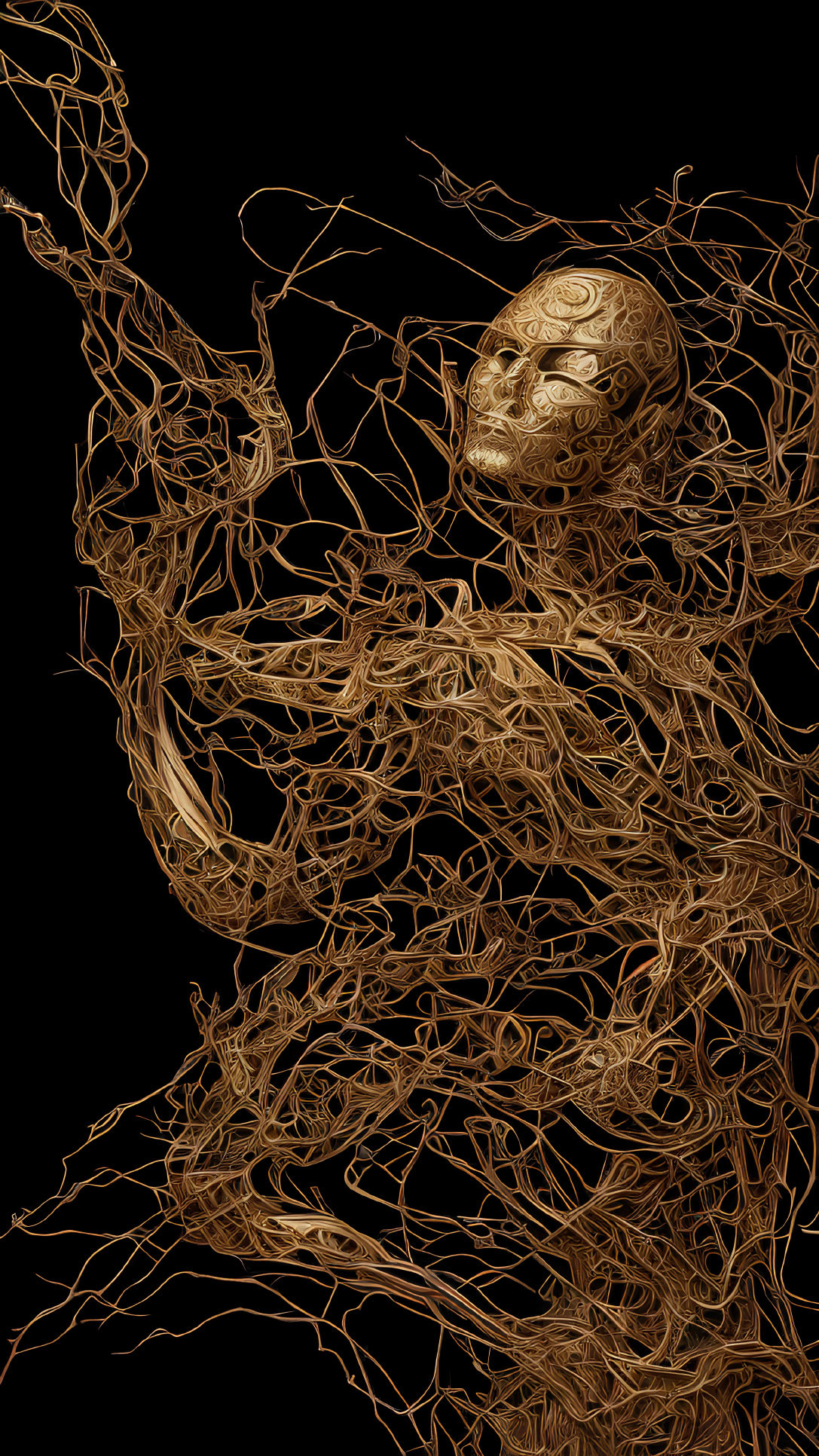
Shodo zen calligraphy. Domo arigato mr roboto. Style of artist Eduard Pronin.
This piece evokes the meditative spontaneity of "Shodō-inspired mark making" yet it translates the gestural philosophy of Zen calligraphy into a sculptural network of golden lines. Instead of brush strokes on rice paper, the composition appears constructed from flowing metallic filaments that behave like strokes suspended in space. The figure emerges gradually from this tangle of lines, suggesting the Zen principle that form arises naturally from motion. The raised arm and upward gaze create a moment of awakening or invocation, as if the figure is being written into existence by an unseen calligrapher. The black void surrounding the subject intensifies this feeling, allowing every filament to function like an intentional stroke within an immense calligraphic field.
The influence reminiscent of Eduard Pronin’s intricate structural aesthetics is evident in the elaborate, almost ornamental complexity of the figure’s surface. The skull and facial features appear etched with delicate patterns, contrasting the chaotic energy of the branching strands that compose the body. This tension between control and improvisation echoes both Zen philosophy and mechanical futurism. The lines twist and braid like neural pathways or circuitry, hinting at a synthetic organism whose form is built from motion rather than matter. In this sense the figure feels both organic and engineered, an entity composed of gestures that resemble both roots and wires.
The phrase "Domo arigato, Mr. Roboto" resonates metaphorically within the image, reinforcing the idea of a machine discovering consciousness through movement and expression. The figure appears caught between automation and enlightenment, as if a robotic body is learning the art of calligraphy through its own structure. The upward-reaching arm becomes a symbolic brushstroke extending beyond the body, a gesture toward transcendence. The result is a visually hypnotic work where Zen minimalism meets cybernetic complexity, transforming calligraphic philosophy into a luminous mechanical organism suspended in darkness.


