Prompt: A dramatic Romantic-era oil painting of an abandoned palace hidden deep within an overgrown forest. The once-grand architecture is now partially ruined — cracked walls, broken windows, and creeping ivy covering its facade.
In front of the palace stands an old stone fountain, long abandoned and overgrown with moss, small plants, and damp greenery. The water is still or barely visible, as if time itself has slowed.
Above, a vast pre-storm sky dominates the scene — heavy dark clouds gathering, illuminated by faint golden light breaking through, creating a powerful contrast between shadow and glow. The air feels charged, full of quiet tension before the storm.
Tall trees surround the palace, their branches slightly bent as if anticipating the coming wind.
Lighting is dramatic and atmospheric, with deep shadows and soft glowing highlights.
Rich oil painting texture, visible expressive brushstrokes, deep greens, greys, muted browns, and subtle golden accents.
Mood: sublime, melancholic, powerful, nature reclaiming human grandeur.
Style inspired by 19th-century Romanticism, emotional, painterly, not photorealistic.
Negative prompt: modern details, clean architecture, photorealism, sharp digital clarity, 3D render, glossy textures.
Original prompt by Mariia93
Prompt: A masterpiece of romantic oil painting of cherry blossom season in Uzhhorod, Ukraine. The scene captures a quiet street lined with blooming sakura trees, their soft pink petals drifting gently through the air. Recognizable Uzhhorod architecture is present: the elegant silhouette of Uzhhorod Castle on the hill in the background, old Austro-Hungarian style buildings with pastel facades, wrought-iron balconies, and narrow cobblestone streets. A glimpse of the Transcarpathian Regional Philharmonic building adds authenticity. Warm spring light filters through the blossoms, creating a dreamy, glowing atmosphere with soft shadows and golden highlights. A few strolling figures add life but remain secondary to the mood. The composition feels poetic and nostalgic, filled with calm and quiet beauty.
Painted in rich oil on canvas, with visible brushstrokes, textured surface, and subtle color blending. Color palette: soft pinks, warm whites, light greens, pale blues, and golden sunlight tones. The mood is airy, romantic, and slightly nostalgic.
Style inspired by Ivan Aivazovsky, but adapted for a spring cityscape — luminous light, emotional atmosphere, and gentle movement in the air, combined with the delicate romanticism of Claude Monet’s late works.
Negative prompt: photorealism, digital art, sharp details, modern cars, contemporary elements, high contrast, oversaturated colors, flat lighting, 3D render, cinematic realism.
Original prompt by Mariia93
Prompt: A highly detailed, photorealistic mosaic-style close-up portrait of Nefertiti in a subtly modern selfie-like composition. The image captures a lifelike, natural appearance while preserving a delicate mosaic texture across the entire surface.
Nefertiti is depicted as a confident and elegant woman with symmetrical facial features, smooth warm-toned skin, almond-shaped eyes with refined kohl eyeliner, and a calm, regal expression. Her face appears highly realistic and photographic, with natural skin texture, soft imperfections, and subtle light reflections — while still being composed of extremely fine, almost imperceptible mosaic tesserae, creating a “living mosaic” effect.
She wears her iconic tall blue crown with gold accents, along with a richly detailed Egyptian broad collar (usekh) in turquoise, lapis, and gold tones. Her linen garment is light and natural, with realistic fabric folds.
The composition strongly suggests a handheld selfie perspective: slight wide-angle lens effect, natural asymmetry, off-center framing, and one shoulder slightly closer to the viewer. No hands or devices visible.
The background is an ancient Egyptian temple interior, clearly visible but slightly softer than the face: tall stone columns, richly decorated walls with hieroglyphs, and painted figures of Egyptian gods in traditional profile poses. The background maintains authentic Egyptian style — flat, symbolic compositions — but rendered with subtle depth and realism.
Lighting is warm, natural sunlight, softly illuminating the face and creating gentle highlights on the skin and crown. The light enhances realism while preserving the handcrafted mosaic texture.
Color palette: warm golden skin tones, sandy beige, turquoise, lapis blue, terracotta, and soft gold.
No exaggerated stylization. Avoid heavy mosaic chunks — tesserae should be very fine and integrated into a near-photographic surface.
Ultra-detailed, cinematic, museum-quality image, blending photorealism with subtle mosaic texture, creating the impression of an ancient figure captured in a modern photograph.
Original prompt by Mariia93
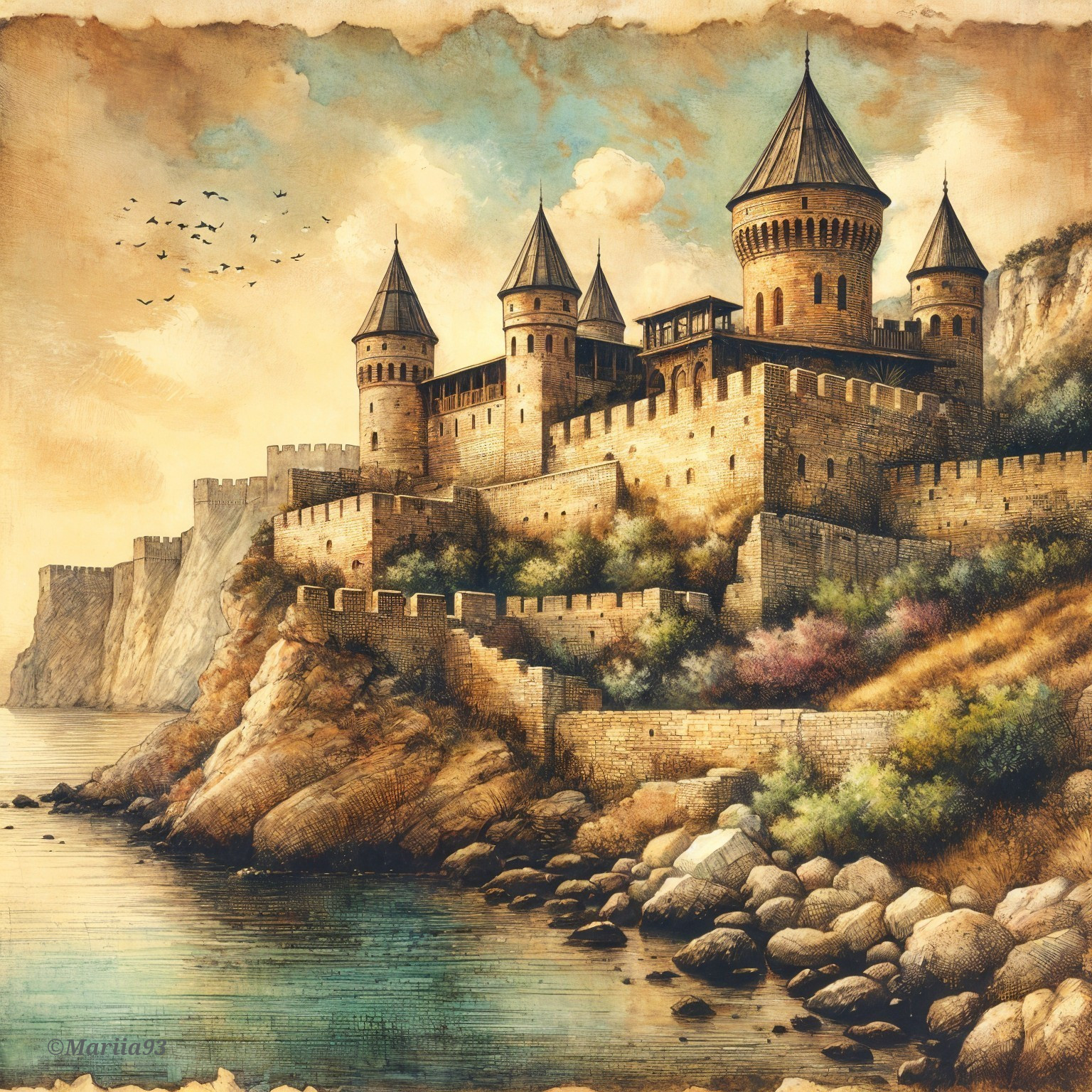
Prompt: A mixed-media picture of Akkerman fortress XIX-th century with traditionalCrimeanarchitecture, created in the style of Bohdan Pylypiv — combining pyrography with delicate watercolor accents. The main outlines and facial features are rendered with fine woodburned lines, rich in sepia tones and texture, pastel colors
Prompt: A pyrography portrait of a Scythian young woman standing proudly against a steppe landscape at sunset. She wears a long ivory linen dress adorned with traditional Scythian embroidery in gold. Around her neck lies an ornate golden pectoral with animal-style motifs — deer, griffins, and birds in intricate patterns. Her long dark hair is braided with beads, and her expression is calm yet fierce, like a warrior-priestess. The mood is mystical and regal, with soft golden light reflecting off the gold. Wet-on-wet watercolor painting in the style of Bohdan Pylypiv — detailed woodburned artwork with elegant contours and expressive shading.
Prompt: A highly detailed, photorealistic close-up mosaic selfie portrait of Emperor Nero during the Great Fire of Rome. The image should feel like an ancient Roman mosaic brought to life as a realistic selfie taken in antiquity — immersive, dramatic, historically grounded, and psychologically unsettling. Nero is depicted as a young Roman emperor in his late twenties, with aristocratic but disturbed features: slightly flushed skin, intense restless eyes, a faint unhinged smile, and an expression balancing fascination, vanity, and madness. His face must not look heroic or idealized — instead emotionally unstable, theatrical, and dangerously self-absorbed.
He wears luxurious imperial Roman garments: an elaborately embroidered crimson toga with gold trim, ornate fibulae, layered jewelry, and a laurel wreath slightly tilted as if carelessly worn. His hair is styled in soft curled Julio-Claudian fashion. The selfie composition should feel natural and immediate, as if Nero himself is documenting the catastrophe behind him.
In the background: Rome engulfed in flames at night. Massive firestorms consume temples, insulae, and marble buildings. Thick smoke rises into a fiery orange-black sky. Roman citizens flee chaotically through narrow streets carrying belongings and children. Some figures look toward the emperor in fear and disbelief. Burning columns collapse in the distance while sparks and embers drift through the air. The atmosphere should feel apocalyptic, feverish, and claustrophobic.
The entire artwork must be rendered as an ultra-detailed ancient mosaic composed of thousands of tiny tesserae. Stone, marble, ceramic, and gold-glass tiles should be clearly visible across skin, clothing, architecture, fire, and smoke. The mosaic texture must remain consistent and physically believable across the entire image. Warm gold, bronze, ember-red, ash-gray, black, and smoky orange tones dominate the palette.
Lighting: dramatic firelight mixed with dim moonlight and glowing reflections from the burning city. The flames illuminate Nero’s face unevenly, emphasizing his unstable expression and creating deep cinematic contrast. Style inspiration: Roman imperial mosaics fused with modern photorealistic cinematic portraiture. The result should feel like a lost masterpiece discovered in Pompeii — beautiful, horrifying, and psychologically charged.
Negative prompt: modern clothing, clean modern beauty standards, fantasy armor, digital smoothness, anime, idealized Hollywood face, futuristic city, low detail, cartoon style, symmetrical perfection, glossy CGI, neon colors, oversaturated lighting, soft Instagram aesthetic, heroic expression, smiling kindly, modern hairstyle, modern makeup. Original prompt by Mariia93.
Prompt: A highly detailed photorealistic mosaic selfie of Queen Zenobia of Palmyra at the height of her power, Palmyra, Syria, 3rd century AD. The image should look like a genuine smartphone selfie taken by a real historical person rather than an illustration, painting, movie scene, statue, or historical reconstruction.
Queen Zenobia stands at the center of the image, extending her arm naturally toward the viewer in a realistic selfie pose. She is a striking and charismatic ruler in her thirties, with refined Middle Eastern features, intelligent dark eyes, olive skin illuminated by warm desert sunlight, and an expression of confidence, dignity, and imperial ambition. Her gaze conveys the authority of a queen who challenged Rome itself and built one of the most powerful kingdoms of the ancient world.
The camera is very close to her face, creating an authentic smartphone selfie perspective with subtle wide-angle lens distortion. Natural sunlight reveals realistic skin texture, pores, subtle imperfections, and lifelike facial details. Her extended arm is clearly visible, reinforcing the impression that she is personally taking the photograph.
Zenobia wears magnificent royal attire inspired by Palmyrene, Syrian, and Eastern Roman traditions. Rich purple and ivory fabrics, elaborate gold jewelry, gemstones, embroidered details, and an ornate royal diadem emphasize her status as ruler of the Palmyrene Empire. Her appearance is regal, authentic, and historically grounded rather than fantasy-inspired.
Behind her rises the breathtaking city of Palmyra at its golden age. Monumental colonnades, temples, triumphal arches, towers, courtyards, palm trees, and bustling streets stretch across the desert landscape. Palmyrene soldiers and banners fill the foreground, emphasizing the strength and prosperity of her realm. The city appears vibrant, wealthy, and magnificent under the warm light of the Syrian desert.
The atmosphere captures a historic moment when Zenobia's empire stood at its greatest extent, ruling vast territories across Syria, Egypt, and the Near East. The mood is triumphant, ambitious, and majestic.
The entire image is rendered as an ultra-realistic ancient Roman-era mosaic composed of thousands of tiny tesserae. Every stone tile is individually visible with natural imperfections, subtle shadows, realistic reflections, and archaeological authenticity. Despite the mosaic medium, the image must retain the appearance of a genuine photograph.
Style: photorealistic mosaic selfie, living history photography, archaeological realism, museum-quality mosaic, cinematic historical documentary, ultra-detailed tesserae, authentic human emotion, candid smartphone photo from antiquity.
Color palette: warm desert gold, sandstone, ivory, bronze, royal purple, deep blue, palm green, sunlit amber.
Negative prompt: painting, illustration, fantasy queen, fantasy armor, medieval princess, movie poster, digital painting, cartoon, anime, statue, marble sculpture, AI-generated look, perfect symmetry, modern makeup, modern clothing, empty background, staged composition, low detail, fantasy city, science fiction, Hollywood beauty. Original prompt by Mariia93
Prompt: Boudica, Queen of the Iceni, during the great rebellion against Rome, 60–61 AD. A highly detailed photorealistic Roman mosaic selfie, as if Boudica herself is taking a smartphone-style self-portrait in the middle of battle.
Boudica fills the foreground, extending her arm toward the viewer in a natural selfie pose. She is a tall, powerful Celtic warrior queen with a natural realistic face, broad light eyebrows, striking pale green eyes, lightly freckled fair skin, and long wild copper-red hair streaming dramatically in the wind. Her features are strong, mature, and believable rather than idealized: high cheekbones, determined expression, subtle imperfections, weathered skin from exposure to the elements, and the presence of a real historical leader rather than a modern fashion model.
She wears authentic Iron Age Celtic clothing, a heavy golden torc around her neck, tribal jewelry, patterned woolen garments, and battle-worn accessories. No glamour makeup, no modern beauty standards, no cosmetic perfection, no Hollywood actress appearance, no fantasy princess look.
Behind her, thousands of Iceni warriors charge into battle. Roman settlements burn in the distance, dark smoke rises into the sky, and the chaos of the rebellion unfolds across the landscape.
The entire image is rendered as an ultra-detailed ancient mosaic composed of thousands of tiny hand-cut tesserae in natural stone, marble, terracotta, and colored glass. Every hair, freckle, wrinkle, and facial feature is carefully formed from mosaic pieces while preserving completely natural human anatomy and realistic proportions.
Expression: fierce determination, intelligence, grief, rage, courage, leadership, and unbreakable resolve.
Color palette: copper red, bronze, gold, earth tones, weathered green, smoke gray, and muted Celtic colors.
Masterpiece, museum-quality Roman mosaic, hyper-detailed tesserae, photorealistic facial anatomy, natural lifelike eyes, realistic skin texture, authentic historical atmosphere, cinematic composition, historically inspired Boudica.
Negative prompt: fashion model, beauty queen, glamour portrait, modern makeup, perfect skin, plastic skin, doll face, cartoon, anime, fantasy princess, Hollywood actress, digital painting look, CGI, 3D render, artificial facial symmetry, exaggerated beauty, youthful Instagram appearance, smooth skin, unrealistic eyes, modern clothing, no SPQR, no SPQR banners, no Roman inscriptions, no Latin text, no letters, no writing, no symbols, no readable text, no typography, no flags with text, no banners with text, no words, no captions, no watermark, no signatures. Original prompt by Mariia93
Prompt: A highly detailed photorealistic mosaic selfie of Spartacus during the Third Servile War, Italy, 72–71 BC. The image should look like a genuine smartphone selfie taken by a real historical person rather than an illustration, painting, movie scene, statue, or historical reconstruction.
Spartacus stands at the center of the image, extending his arm toward the viewer in a natural selfie pose. He is a powerful Thracian warrior in his late thirties, with realistic Mediterranean features, weathered skin, dark curly hair, a short beard, intelligent eyes, and the rugged appearance of a man hardened by years of slavery, gladiatorial combat, and warfare. His face shows determination, confidence, and the excitement of leading a successful rebellion. The rebellion is at its peak. Looking directly into the camera, Spartacus appears fully aware that he is changing the course of history, carrying the hopes of thousands who fight for their freedom.
The camera is very close to his face, creating an authentic smartphone selfie perspective with subtle wide-angle lens distortion. Natural sunlight reveals realistic skin texture, pores, sweat, scars, stubble, wrinkles, and lifelike facial details. His extended arm is clearly visible, reinforcing the impression that he is personally taking the photograph.
Behind him unfolds the slave uprising at its height. Thousands of escaped slaves, gladiators, and rebel warriors fill the landscape. Some raise captured Roman standards, shields, and weapons in celebration. Others gather around campfires, train for battle, repair equipment, or prepare for the next campaign. The atmosphere is energetic, hopeful, and revolutionary rather than chaotic.
The setting is southern Italy near the slopes of Mount Vesuvius. Rocky hills, olive trees, tents, wagons, campfires, and a vast rebel encampment stretch into the distance. The scene should feel historically authentic and immediately recognizable as Spartacus' rebellion against Rome.
Spartacus wears practical gladiatorial and military equipment assembled from captured Roman armor and personal gear rather than a polished Roman officer's uniform. His appearance should reflect a rebel leader who rose from slavery, not a Roman nobleman.
The entire image is rendered as an ultra-realistic ancient Roman mosaic composed of thousands of tiny tesserae. Every stone tile is individually visible with natural imperfections, subtle shadows, realistic reflections, and archaeological authenticity. Despite the mosaic medium, the image must retain the appearance of a genuine photograph.
Style: photorealistic mosaic selfie, living history photography, Roman archaeological realism, museum-quality mosaic, cinematic historical documentary, ultra-detailed tesserae, authentic human emotion, candid smartphone photo from antiquity.
Negative prompt: painting, illustration, fantasy warrior, medieval knight, polished Roman general, movie poster, heroic pose, fantasy armor, digital painting, cartoon, statue, marble sculpture, AI-generated look, perfect symmetry, low detail, empty background, modern clothing, horse, fantasy battlefield, Hollywood gladiator. Original prompt by Mariia93
Prompt: A highly detailed photorealistic mosaic selfie of Pontius Pilate in Jerusalem around 30 AD. The image should look like a genuine smartphone selfie taken by a real historical person rather than an illustration, painting, religious icon, or historical reconstruction.
Pontius Pilate stands on the elevated stone balcony of the Praetorium, extending his arm toward the viewer in a natural selfie pose. He is a middle-aged Roman governor with realistic Mediterranean features, short dark hair touched with gray, intelligent eyes, weathered skin, and a thoughtful, conflicted expression. He appears as a real human being facing a difficult political decision, not a heroic figure or villain.
The camera is very close to his face, creating an authentic smartphone selfie perspective with subtle wide-angle lens distortion, natural depth of field, realistic sunlight, skin texture, pores, wrinkles, and lifelike facial details. His extended arm is clearly visible, reinforcing the impression that he is personally taking the photograph.
Behind him, clearly visible and immediately recognizable, the trial of Jesus is unfolding in the courtyard below. Jesus stands at the center of the composition wearing a simple light-colored robe, surrounded by Roman soldiers, temple officials, and a large crowd. Animated crowd, raised hands, emotional reactions, intense public atmosphere. The scene should be large enough and sharp enough that viewers instantly understand what historical event is taking place.
Pilate stands on the balcony overlooking the crowd, while Jesus remains positioned prominently in the background rather than hidden among secondary figures. The visual storytelling should make both Pilate and Jesus important parts of the same image.
The famous 'Ecce Homo' moment is taking place below, with Jesus clearly visible before the crowd while Pilate watches from the balcony.
Ancient Jerusalem stretches into the distance with authentic first-century architecture, stone streets, arches, columns, rooftops, banners, and warm golden afternoon light. The atmosphere feels historically grounded, documentary-like, and cinematic.
The entire image is rendered as an ultra-realistic ancient Roman mosaic composed of thousands of tiny tesserae. Every stone tile is individually visible with natural imperfections, realistic shadows, subtle reflections, and archaeological authenticity. Despite the mosaic medium, the image must retain the appearance of a genuine photograph.
Style: photorealistic mosaic selfie, living history photography, Roman archaeological realism, museum-quality mosaic, cinematic historical documentary, ultra-detailed tesserae, authentic human emotion, candid smartphone photo from antiquity.
Negative prompt: painting, illustration, fantasy art, religious icon, halo, saint imagery, medieval clothing, medieval architecture, theatrical posing, heroic poster, digital painting, AI-generated look, cartoon, statue, marble sculpture, blurry background, hidden Jesus, tiny background figures, empty courtyard, exaggerated facial beauty, perfect symmetry, low detail. Original prompt by Mariia93.
Prompt: A highly detailed photorealistic mosaic selfie of Gaius Julius Caesar during the crossing of the Rubicon, northern Italy, 49 BC. The image should look like a genuine smartphone selfie taken by a real historical person rather than an illustration, painting, movie scene, statue, or historical reconstruction.
Gaius Julius Caesar stands at the center of the image, extending his arm naturally toward the viewer in a realistic selfie pose. He is a charismatic Roman statesman and military commander in his early fifties, with realistic Mediterranean features, intelligent eyes, weathered skin, short dark hair touched with gray, and the confident expression of a man about to alter the course of history.
His face reveals determination, ambition, and calm resolve. Looking directly into the camera, Caesar appears fully aware that a single decision made on this day will transform the Roman Republic forever. The famous moment of "Alea iacta est" — "The die is cast" — feels imminent.
The camera is very close to his face, creating an authentic smartphone selfie perspective with subtle wide-angle lens distortion. Natural winter daylight reveals realistic skin texture, wrinkles, pores, stubble, and lifelike facial details. His extended arm is clearly visible, reinforcing the impression that he is personally taking the photograph.
Behind him, Roman legionaries are crossing the shallow waters of the Rubicon River. Soldiers carry standards bearing the eagle of Rome, shields, spears, and marching equipment. Officers ride among the troops while banners move in the cold wind. The atmosphere is tense and historic rather than celebratory.
The landscape of northern Italy stretches behind the army with rolling hills, winter vegetation, muddy riverbanks, and a gray-blue sky. The scene captures the exact moment when Caesar commits himself and his army to civil war.
Caesar wears historically accurate late Republican military attire: a red commander's cloak, decorated cuirass, practical campaign equipment, and symbols of rank appropriate to a Roman general. His appearance should feel authentic and human rather than idealized.
The entire image is rendered as an ultra-realistic ancient Roman mosaic composed of thousands of tiny tesserae. Every stone tile is individually visible with natural imperfections, subtle shadows, realistic reflections, and archaeological authenticity. Despite the mosaic medium, the image must retain the appearance of a genuine photograph.
Style: photorealistic mosaic selfie, living history photography, Roman archaeological realism, museum-quality mosaic, cinematic historical documentary, ultra-detailed tesserae, authentic human emotion, candid smartphone photo from antiquity.
Negative prompt: painting, illustration, fantasy Roman, medieval knight, movie poster, digital painting, cartoon, statue, marble sculpture, perfect symmetry, heroic pose, AI-generated look, modern clothing, modern objects, fantasy armor, empty background, staged composition.
Original prompt by Mariia93.
Prompt: A highly detailed photorealistic mosaic selfie of Confucius (Kong Fuzi) in the State of Lu, 5th century BC. The image should look like a genuine smartphone selfie taken by a real historical person rather than a painting, illustration, statue, movie scene, or historical reconstruction. Every surface, including skin, hair, clothing, architecture, sky, and background elements, is composed entirely of thousands of tiny hand-laid mosaic tesserae.
Confucius stands at the center of the image, extending his arm toward the viewer in a natural selfie pose. He appears as a wise elderly Chinese philosopher with a calm, thoughtful expression, deep intelligent eyes, a neatly groomed mustache and beard, and dignified features. He wears elegant yet modest robes appropriate to a respected scholar and teacher of ancient China.
Behind him is a lively academy courtyard in the State of Lu. Students gather in small groups, listening to lessons, reading bamboo scrolls, discussing philosophy, and practicing calligraphy. Traditional Chinese wooden halls, tiled roofs, banners, stone pathways, cypress trees, and distant hills create an authentic setting. The atmosphere conveys learning, wisdom, and cultural refinement.
Warm golden afternoon sunlight illuminates the scene, creating realistic shadows and highlights across the mosaic tiles. The composition should resemble a candid photograph captured during a real moment in history.
Ultra-detailed mosaic tesserae, photorealistic facial features, authentic Zhou-era Chinese clothing and architecture, natural colors, historical accuracy, immersive atmosphere, masterpiece quality, 8k resolution.
Original prompt by Mariia93.
Prompt: A highly detailed photorealistic mosaic selfie of Herod Antipas during the famous banquet where Salome performs her dance, Galilee, early 1st century AD. The image should look like a genuine smartphone selfie taken by a real historical person rather than an illustration, painting, movie scene, statue, or historical reconstruction.
Herod Antipas stands at the center of the image, extending his arm toward the viewer in a natural selfie pose. He is a middle-aged ruler with realistic Middle Eastern features, olive-toned skin, intelligent eyes, carefully groomed dark hair touched with gray, and the dignified appearance of a wealthy tetrarch of Galilee. His expression reflects fascination, pride, and amusement as he enjoys the lavish celebration unfolding around him.
The camera is very close to his face, creating an authentic smartphone selfie perspective with subtle wide-angle lens distortion. Natural warm torchlight reveals realistic skin texture, pores, wrinkles, stubble, and lifelike facial details. His extended arm is clearly visible, reinforcing the impression that he is personally taking the photograph.
Behind him unfolds one of the most famous banquets of the ancient world. Salome is captured in mid-dance before the assembled guests, her graceful movement becoming the center of attention in the grand banquet hall. Nobles, military officers, wealthy courtiers, and honored guests watch with admiration. Servants carry silver platters, wine vessels, fruits, bread, and luxurious dishes. The atmosphere is festive, elegant, and filled with anticipation.
The setting is Herod's palace banquet hall, richly decorated with marble columns, colorful fabrics, oil lamps, gold ornaments, carved stone architecture, and luxurious furnishings appropriate to a client ruler of the Roman Empire. The hall glows with warm evening light, creating a dramatic and memorable scene.
Looking directly into the camera, Herod appears unaware that this celebration will soon become one of the most infamous moments in biblical history. The mood captures the final moments of carefree luxury before a decision that will echo through the centuries.
Herod wears luxurious royal garments with richly embroidered fabrics, fine jewelry, a ceremonial cloak, and clothing reflecting the wealth and status of a Herodian ruler. His appearance should be historically plausible and grounded rather than theatrical or fantasy-inspired.
The entire image is rendered as an ultra-realistic ancient Roman mosaic composed of thousands of tiny tesserae. Every stone tile is individually visible with natural imperfections, subtle shadows, realistic reflections, and archaeological authenticity. Despite the mosaic medium, the image must retain the appearance of a genuine photograph.
Style: photorealistic mosaic selfie, living history photography, ancient palace realism, museum-quality mosaic, cinematic historical documentary, ultra-detailed tesserae, authentic human emotion, candid smartphone photo from antiquity.
Negative prompt: painting, illustration, fantasy king, medieval castle, crown jewels, movie poster, theatrical stage performance, fantasy palace, digital painting, cartoon, statue, marble sculpture, AI-generated look, perfect symmetry, low detail, modern clothing, modern furniture, fantasy architecture, Hollywood biblical epic. Original prompt by Mariia93
Prompt: A highly detailed photorealistic mosaic selfie of Alexander the Great immediately after his victory at the Battle of Gaugamela in 331 BC. The image should look like a genuine smartphone selfie taken by a real historical person rather than an illustration, painting, historical reconstruction, movie still, or fantasy artwork.
Alexander stands on the battlefield moments after the decisive victory, extending his arm toward the viewer in a natural selfie pose. He is a young Macedonian king with realistic Mediterranean features, expressive eyes, slightly windblown wavy blond-brown hair, sun-touched skin, and the appearance of a real living human captured by a camera. His expression is calm, proud, thoughtful, and victorious rather than theatrical or exaggerated.
He wears an ornate Macedonian cuirass decorated with realistic gold details, a white military cloak draped over his shoulders, and authentic battlefield equipment appropriate to the late 4th century BC. The armor should appear practical and battle-worn rather than ceremonial.
Behind him stretches the vast battlefield of Gaugamela. Thousands of Macedonian soldiers celebrate their victory, raising sarissas, shields, and royal banners. Persian forces can be seen retreating in the distance. Scattered shields, abandoned weapons, broken chariots, dust clouds, and the aftermath of battle create historical realism. The scene feels alive and spontaneous, as if captured in a real historical moment.
IMPORTANT: The entire image is created as an ultra-realistic ancient mosaic made from thousands of tiny tesserae. Every surface—including skin, eyes, hair, armor, clothing, sky, battlefield, banners, soldiers, dust, and distant landscape—is constructed entirely from visible mosaic tiles. The mosaic must remain highly detailed and convincing while preserving the appearance of a real photograph.
Natural sunlight, authentic historical atmosphere, realistic depth of field, subtle imperfections, candid composition, slight arm distortion typical of smartphone selfies, spontaneous moment, documentary photography feel.
Ultra-detailed photorealistic mosaic, living human appearance, realistic facial proportions, natural skin texture, expressive eyes, authentic historical setting, masterpiece, 8k, extraordinary realism.
Negative prompt: painting, illustration, concept art, fantasy hero, movie poster, CGI, 3D render, cartoon, comic book, idealized face, overly handsome, modern clothing, modern objects, studio lighting, artificial pose, symmetrical composition, digital art look, static portrait, emotionless expression, book cover, historical painting, museum artwork. Original prompt by Mariia93
Prompt: A highly detailed cinematic mosaic selfie portrait of Agrippina the Younger standing inside the imperial palace of Julio-Claudian Rome during the height of her political influence. Agrippina is depicted as a strikingly intelligent and aristocratic Roman noblewoman with historically grounded Mediterranean features inspired by surviving Roman busts and coins: pale olive skin, dark expressive eyes, a strong patrician nose, softly aged realistic skin, full natural lips, and thick dark brown hair styled in an elaborate authentic Julio-Claudian coiffure with carefully arranged waves, braided sections, and intricate curls woven with subtle gold pins and pearls. Her eyebrows are natural, fuller, and historically realistic rather than modern sculpted beauty standards. Her beauty feels severe, charismatic, politically dangerous, and intellectually commanding rather than glamorous or cinematic-perfect. Expression: calm, calculating, emotionally controlled, with the poised gaze of a woman fully aware of imperial power and palace intrigue.
Wardrobe: luxurious Roman stola and palla in ivory, deep crimson, muted gold, and dark olive tones, decorated with refined embroidery and woven borders inspired by elite Roman aristocratic fashion. Jewelry: elegant but restrained Roman imperial adornments — layered gold necklaces, cameos, pearls, delicate earrings, engraved gemstones, and subtle symbols of dynastic status rather than fantasy opulence.
Environment: the imperial palace on the Palatine Hill rendered with monumental realism — marble columns, frescoed walls, bronze oil lamps, drifting incense smoke, Roman statues, glimpses of senators and attendants softly blurred in the background, and distant views of Rome glowing in warm evening light through open colonnades. The atmosphere suggests political tension, ambition, intellect, and hidden danger within the imperial court.
Lighting: warm golden Mediterranean sunlight mixed with soft lamp glow, subtle volumetric haze, rich marble reflections, and natural cinematic shadow depth. Composition: realistic cinematic selfie framing with natural asymmetry and believable depth, as if captured in a historically grounded epic film still. Style: hyper-detailed ancient Roman mosaic blended with cinematic realism and fine-art historical reconstruction. Tiny tesserae mosaic tiles remain visible across skin, fabrics, jewelry, architecture, and light while preserving believable anatomy and emotional realism.
Mood: imperial ambition, restrained Roman elegance, political intelligence, dynastic power, feminine authority, and the dangerous sophistication of early imperial Rome.
Negative prompt: Hollywood empress glamour, fantasy queen aesthetics, modern makeup trends, Instagram influencer beauty, plastic skin, anime, medieval queen styling, exaggerated luxury, fantasy jewelry, perfect symmetrical face, glossy CGI, modern salon hairstyle, hypersexualized appearance, sci-fi Rome, Disney aesthetics. Original prompt by Mariia93.
Prompt: A highly detailed photorealistic ancient mosaic selfie portrait of Alexander the Great riding horseback during a military campaign. Alexander is shown as a charismatic young Macedonian king in his early twenties, with wavy golden-brown hair, intense light eyes, and a confident expression filled with ambition and destiny. He is riding his legendary black horse Bucephalus while taking a selfie-like portrait from horseback, his arm extended naturally toward the viewer.
Behind him stretches the vast Macedonian army: rows of soldiers carrying long sarissas, fluttering banners, bronze armor glimmering in the sunlight, cavalry units, and distant formations disappearing into the dusty horizon. The atmosphere feels epic and historical, like a real moment captured during conquest.
Alexander wears richly decorated bronze armor with intricate Hellenistic motifs, a deep red cloak flowing dramatically in the wind, and subtle golden details inspired by ancient Macedonian craftsmanship. Bucephalus appears powerful and noble beside him, partially visible in the foreground with ornate tack and battle gear.
The entire image is rendered as an authentic ancient Roman/Byzantine-style mosaic made from thousands of tiny tesserae stones. The mosaic texture is clearly visible across skin, armor, horse, sky, and battlefield. Warm golden sunlight, dusty air, cinematic depth, realistic ancient atmosphere, historically inspired styling, dramatic but believable composition.
Color palette: warm gold, bronze, ivory, dusty beige, muted red, stone gray.
Style: photorealistic ancient mosaic, archaeological masterpiece, cinematic historical realism, highly detailed tesserae texture, museum-quality Roman mosaic aesthetic.
Negative prompt: modern clothing, fantasy armor, anime, digital painting look, smooth plastic skin, futuristic elements, text, watermark, low detail, cartoon, oversaturated colors, perfect modern hairstyle. Original prompt by Mariia93
Prompt: A richly detailed classical still life celebrating the beginning of strawberry season, painted in a refined traditional fine art style with subtle elements of Impressionism. A large porcelain bowl overflowing with ripe, freshly picked strawberries stands on a sunlit garden table covered with an elegant white linen tablecloth. Nearby are delicate vintage teacups, a small ceramic milk jug with floral ornamentation, scattered strawberry blossoms, and soft summer flowers in glass vases. Warm golden afternoon sunlight filters through blooming garden trees, creating shimmering highlights, soft shadows, and luminous reflections on the fruit and porcelain. The atmosphere is dreamy, nostalgic, and romantic — evoking the joy of early summer and the sweetness of the first strawberries of the season. Visible painterly brushstrokes, rich oil paint texture, subtle color vibration, and light-filled Impressionist touches inspired by Claude Monet and Pierre-Auguste Renoir, while maintaining the elegance and composition of classical European still life painting. Color palette: deep strawberry reds, creamy whites, soft pinks, warm greens, golden sunlight. Medium: oil on canvas, highly painterly, luminous, poetic, authentic fine art aesthetic. Negative prompt: photorealism, modern objects, digital art, 3D render, hyperrealism, artificial lighting, oversharpening, flat composition, text, watermark. Original prompt by Mariia93
Prompt: A highly detailed cinematic mosaic selfie portrait of Hannibal standing in a Carthaginian military encampment during the Second Punic War, shortly after crossing the Alps. Hannibal is depicted as a charismatic and battle-hardened North African–Phoenician commander in his 40s, with historically inspired Mediterranean features: warm bronze-olive skin, sharp intelligent dark eyes, a strong aquiline nose, thick dark curly hair, and a short well-kept beard touched slightly by hardship and war. His expression is calm, strategic, fearless, and intensely observant — the gaze of a commander capable of challenging Rome itself.
Wardrobe: luxurious but practical Carthaginian military attire blending Phoenician, North African, and Hellenistic influences — layered linen and deep crimson garments beneath ornate bronze armor with subtle Punic motifs, dark blue fabrics, leather straps, and weathered military textures. Accessories include finely crafted gold armbands, Phoenician jewelry, and an elegant commander’s cloak moving in the mountain wind. No Roman aesthetics.
Environment: a monumental Carthaginian war camp rendered with cinematic realism — distant war elephants, Numidian cavalry, Punic banners, burning braziers, rugged Alpine mountains, and soldiers preparing for battle. Hints of snow, smoke, campfires, bronze weapons, and dramatic Mediterranean twilight create a feeling of exhaustion, ambition, and military genius. The background subtly blends Carthaginian luxury with the brutal reality of the campaign against Rome.
Lighting: warm golden firelight mixed with cold mountain atmosphere, soft cinematic shadows, glowing smoke, bronze reflections, and dramatic volumetric rays through mist and snowfall.
Composition: realistic cinematic selfie framing with natural asymmetry and believable depth, as if captured in an epic historical film grounded in archaeological realism. Style: hyper-detailed ancient mosaic blended with cinematic realism and fine-art historical reconstruction. Tiny tesserae mosaic tiles remain visible across skin, armor, fabrics, elephants, mountains, and firelight while preserving believable anatomy and emotional realism.
Mood: military brilliance, endurance, ambition, exotic power, looming conflict with Rome, and the tragic grandeur of Carthage.
Negative prompt: Roman general aesthetics, fantasy barbarian king, Viking appearance, glossy CGI, Hollywood superhero armor, modern military look, anime, plastic skin, influencer aesthetics, medieval knight armor, futuristic fantasy, oversized fantasy weapons, perfect symmetrical face, sci-fi Carthage. Original prompt by Mariia93.
Prompt: A highly detailed cinematic mosaic selfie portrait of Sappho standing on a marble seaside terrace on the island of Lesbos during the Archaic Greek period. Sappho is depicted as a naturally beautiful and intellectually captivating Greek poetess with warm olive-toned skin, broad natural dark eyebrows typical of antiquity, expressive almond-shaped brown eyes, softly tired eyelids, and slightly asymmetrical realistic facial features. Her beauty feels human, soulful, and historically grounded rather than glamorous or modern. Thick dark curly Mediterranean hair is gathered loosely in authentic ancient Greek braids with windswept strands, delicate gold ribbons, and subtle ornaments.
Expression: introspective, emotionally observant, poetic, and melancholic — the calm gaze of a woman composing verses about longing, memory, beauty, and desire.
Wardrobe: flowing white Ionic Greek garments with faded saffron and terracotta embroidered borders inspired by authentic Archaic Greek textiles, layered natural fabrics gently moving in the sea breeze. Jewelry: restrained ancient Greek adornments with thin gold necklaces, small pearls, carved beads, and elegant filigree earrings.
Environment: a dreamlike but archaeologically grounded terrace overlooking the glowing Aegean Sea at sunset. Marble columns, olive trees, flowering vines, bronze oil lamps, ceramic amphorae, poetry scrolls, and women musicians playing lyres appear softly in the background. Distant Greek ships sail beneath golden Mediterranean light.
Lighting: warm sunset glow with amber reflections across marble, sea, skin, and mosaic tesserae, subtle sea haze, soft shadows, and cinematic atmospheric depth.
Composition: realistic cinematic selfie framing with natural asymmetry and believable proportions, as if captured in a lost historical film from the ancient Greek world.
Style: hyper-detailed ancient mosaic blended with cinematic realism and fine-art archaeological reconstruction. Tiny tesserae mosaic tiles remain clearly visible across skin, fabrics, sea, sky, and architecture while preserving emotional realism and natural imperfections.
Mood: lyrical melancholy, feminine intellect, poetic longing, intimacy, memory, music, and the fading golden beauty of ancient Greece.
Negative prompt: Hollywood beauty standards, flawless symmetrical face, modern influencer aesthetics, glossy CGI, fashion photography look, hypersexualized appearance, fantasy princess, anime, artificial beauty filters, modern makeup trends, futuristic Greece, perfect salon hairstyle, medieval fantasy styling, Disney aesthetics. Original prompt by Mariia93.
Prompt: A mixed-media picture of a Chinese traditional spring garden by the lake, created in the style of Bohdan Pylypiv — combining pyrography with delicate watercolor accents. The main outlines and facial features are rendered with fine woodburned lines, rich in sepia, yellow, green tones and texture.
Prompt: A highly detailed cinematic mosaic selfie portrait of Thucydides standing inside classical Athens during the late 5th century BCE, depicted as an intelligent and observant Athenian historian and former general. He has realistic ancient Greek features inspired by surviving classical busts: olive-toned Mediterranean skin, deep thoughtful eyes, a strong straight nose, defined cheekbones, short dark wavy hair, and a neatly trimmed beard with subtle gray strands. His expression is calm, analytical, and emotionally restrained — the gaze of a man carefully observing war, politics, and human nature. He wears elegant but modest classical Greek himation robes in ivory, muted ochre, and deep bronze tones, with realistic woven textures rather than luxurious royal fabrics. Environment: the intellectual and political atmosphere of classical Athens — marble colonnades, olive trees, bronze statues, distant views of the Acropolis, scrolls and wax tablets, philosophers and scribes softly blurred in the background, hints of the Peloponnesian War through distant triremes and soldiers. Lighting: warm Mediterranean sunlight with soft golden haze and subtle cinematic shadows. Composition: realistic cinematic selfie framing with natural asymmetry and believable depth, as if captured in a historical epic grounded in archaeological realism. Style: hyper-detailed ancient mosaic blended with cinematic realism and fine-art historical reconstruction. Tiny tesserae mosaic tiles remain visible across skin, fabric, marble, and architecture while preserving realistic anatomy and emotional subtlety. Mood: intellectual gravity, political tension, historical memory, realism, and the fading golden age of Athens. Negative prompt: fantasy philosopher, medieval monk aesthetics, modern hairstyle, Hollywood glamour, glossy CGI, anime, perfect symmetrical face, fantasy robes, sci-fi Greece, exaggerated heroism, artificial beauty filters. Original prompt by Mariia93.
Prompt: A highly detailed, photorealistic close-up mosaic portrait of Pharaoh Ramesses II, Ancient Egypt.
The entire image is rendered as an ultra-fine ancient mosaic made of thousands of tiny hand-cut stone and ceramic tesserae. Each tessera varies slightly in tone, size, and orientation, creating a subtle shimmering surface that reacts to light realistically.
Ramesses is depicted as a middle-aged ancient Egyptian man with authentic ethnic features: warm bronze-brown skin tone with golden undertones, slightly elongated facial structure, high cheekbones, almond-shaped deep brown eyes with a natural upward tilt, a straight nose with a broader base, and full, well-defined lips. His facial structure must reflect ancient Egyptian artistic canon — slightly idealized, symmetrical but not artificial, with a calm and timeless geometry.
His skin is composed of extremely fine mosaic tiles, yet appears soft and lifelike from a distance. Subtle irregularities in tesserae placement create natural skin transitions, faint wrinkles around the eyes and mouth, and gentle sun exposure — avoiding any plastic or digital smoothness.
He is clean-shaven, wearing a traditional ceremonial false beard (curved and rigid, symbolic rather than naturalistic), attached to the chin and rendered in darker stone tesserae.
He wears the nemes headdress with deep cobalt blue and gold stripes. The uraeus cobra on the forehead is clearly defined, slightly raised in relief, with precise geometric detailing.
Around his neck is a broad usekh collar composed of intricate rows of gold, lapis lazuli, turquoise, and carnelian tesserae. The collar follows strict Egyptian symmetry and pattern repetition, with slight material imperfections that enhance realism.
The clothing and adornments are stylized according to ancient Egyptian visual language — flat, symbolic, rhythmic patterns rather than soft fabric folds.
Background: an interior of a monumental ancient Egyptian temple, fully rendered in mosaic. Massive stone columns, carved reliefs, and hieroglyphs are visible. The reliefs depict figures in strict Egyptian profile and canonical proportions, slightly flatter and more graphic than the portrait, creating contrast between realism and tradition.
Depth of field: shallow, with the face in sharp focus and the background softly receding, but still readable.
Lighting: warm desert sunlight entering from one side, creating soft highlights across the face and subtle shadows between tesserae. Light enhances the three-dimensionality of the mosaic surface.
Color palette: harmonious and historically grounded — sandstone beige, warm gold, deep cobalt blue, muted turquoise, earthy reds.
Atmosphere: dry, ancient, monumental — a sense of stillness, heat, and eternity.
Mood: regal, distant, divine authority. The expression is neutral, composed, and timeless — no smile, no modern emotional cues.
Style: a fusion of hyperrealism and ancient Egyptian sculpture translated into mosaic form. The image should feel like a living relic — as if an ancient wall mosaic has come to life.
Surface detail: micro-cracks, slight wear on some tesserae edges, subtle aging, but overall well-preserved.
No European facial structure, no modern facial proportions, no Hollywood actor resemblance, no modern grooming or hairstyle, no glossy or plastic skin, no photographic studio lighting
Original prompt by Mariia93
Prompt: A highly detailed cinematic mosaic selfie portrait of King Leonidas I of Sparta standing among the warriors at Thermopylae shortly before battle. Leonidas is depicted as a historically grounded Spartan king in his зрелі роки — powerful, disciplined, weathered, and charismatic rather than fantasy-like or bodybuilder-perfect. His face is strong and realistic: deep-set dark eyes, sun-tanned Mediterranean skin, pronounced cheekbones, a straight noble nose, short dark curly hair touched by dust and sweat, and a thick dark beard with subtle gray strands. His expression is calm, fearless, intelligent, and emotionally controlled — the gaze of a commander fully aware of his fate yet unshaken by it.
Wardrobe and armor: authentic classical Spartan bronze cuirass partially covered by a deep crimson cloak fastened with simple bronze clasps, weathered leather straps, and realistic battle-worn details. Corinthian helmet held under one arm or partially visible nearby, historically grounded rather than stylized fantasy armor. No exaggerated muscles, no Hollywood “300” aesthetics.
Environment: the rocky pass of Thermopylae at golden sunset, with disciplined Spartan hoplites, long spears, shields, dust, distant cliffs, and faint campfires softly blurred in the background. Ancient Greek atmosphere with realism and gravity rather than spectacle. Warm Mediterranean sunlight mixed with drifting smoke and sea haze creates soft cinematic volumetric light.
Composition: realistic ancient “selfie” framing as if captured in a historical epic grounded in archaeological realism, with natural asymmetry and believable depth. Style: hyper-detailed ancient mosaic blended with cinematic realism and fine-art historical reconstruction. Tiny tesserae mosaic tiles remain visible across skin, beard, cloak, bronze armor, and stone surroundings while preserving realistic anatomy and emotional depth.
Mood: heroic sacrifice, discipline, stoic courage, brotherhood, fading sunlight before battle, and the immortal legacy of Sparta.
Negative prompt: fantasy Spartan king, “300” movie aesthetics, superhero body, glossy CGI, modern haircut, Viking appearance, medieval knight armor, exaggerated masculinity, anime, plastic skin, fantasy weapons, sci-fi Sparta, perfect symmetrical face, Hollywood action hero, modern gym physique. Original prompt by Mariia93.
Prompt: A highly detailed cinematic mosaic selfie portrait of Cleopatra VII inside the royal palace of Ptolemaic Alexandria at the height of her reign. Cleopatra is depicted as a strikingly beautiful and charismatic Hellenistic-Egyptian queen with refined Eastern Mediterranean features inspired partly by surviving Ptolemaic coin portraits: warm olive-toned skin, expressive almond-shaped brown eyes with elegant ancient Egyptian kohl eyeliner and elongated painted eye lines, a noble aquiline nose, softly defined lips, high cheekbones, and thick dark Mediterranean hair styled in historically grounded Ptolemaic braids with subtle natural waves, gold ornaments, beads, and delicate tassels. Her beauty feels regal, intelligent, magnetic, and politically powerful rather than modern or artificial. Expression: calm, confident, emotionally controlled, with the poised gaze of a queen negotiating with emperors. Wardrobe: luxurious white linen garments inspired by authentic Ptolemaic-Egyptian royal fashion with deep royal blue, crimson, ivory, and gold embroidery. Jewelry: ornate traditional Egyptian and Hellenistic jewelry with layered gold collar necklaces, lapis lazuli, turquoise, carnelian, pearls, delicate chains, and gemstone inlays. Crown / headdress: authentic Ptolemaic gold diadem with a central uraeus cobra symbol, intricate Egyptian detailing, blue faience accents, and refined ancient craftsmanship. Environment: the palace of Alexandria rendered with monumental realism — papyrus-inspired columns, marble halls, bronze oil lamps, incense smoke glowing in warm Mediterranean sunlight, Egyptian motifs blended with Hellenistic Greek architecture, hints of the harbor of Alexandria and distant ships visible through palace openings, blurred scribes and papyrus scrolls in the background. Lighting: warm cinematic Mediterranean sunlight, soft volumetric rays, glowing incense haze, rich gold reflections, and subtle shadow depth. Composition: realistic cinematic selfie framing with natural asymmetry and believable depth. Style: hyper-detailed ancient mosaic blended with cinematic realism and fine-art historical reconstruction. Tiny tesserae mosaic tiles remain visible across skin, fabric, jewelry, and architecture while preserving believable anatomy and emotional realism. Mood: royal elegance, feminine power, sacred beauty, political brilliance, and the fading glory of the Hellenistic world before Rome. Negative prompt: modern influencer aesthetics, plastic skin, glossy CGI, Hollywood glamour queen, anime, fantasy princess, medieval crown, futuristic Egypt, hypersexualized appearance, Disney aesthetics, modern salon hairstyle, oversized fantasy jewels, elf aesthetics, perfectly symmetrical face, beauty filters, sci-fi Cleopatra, Roman empress styling, fantasy armor. Original prompt by Mariia93.
Prompt: A highly detailed cinematic mosaic selfie portrait of Augustus Caesar standing inside the marble halls of imperial Rome shortly after the establishment of the Roman Empire. Augustus is depicted as a mature Roman ruler with authentic Mediterranean / Italic features: olive-toned skin, sharp deep-set brown eyes, aquiline Roman nose with a slightly sharper bridge, defined cheekbones, lean facial proportions, strong jawline, slightly wavy dark brown hair carefully styled in the recognizable Augustan fashion with subtle strands falling forward onto the forehead. His face appears intelligent, disciplined, restrained, and politically calculating rather than overtly emotional. Expression: calm authority, controlled confidence, restrained ambition, and the cold composed gaze of a ruler who survived civil wars and transformed Rome forever. His appearance should feel subtly aged and realistic — around 40–50 years old — with faint wrinkles, slight asymmetry, under-eye fatigue, thinner lips, weathered skin texture, and the quiet psychological weight of power. Avoid modern Hollywood perfection or idealized youthful beauty. Wardrobe: historically inspired early Imperial Roman garments — an elegant ivory toga with rich crimson borders and subtle gold embroidery, layered over a finely detailed tunic. A realistic Roman military cloak (paludamentum) drapes naturally over one shoulder. On his chest are restrained imperial ornaments inspired by Roman ceremonial regalia, refined and aristocratic rather than fantasy-like. No medieval king aesthetics. No fantasy armor. Laurel wreath (STRICT): authentic Roman golden laurel corona with delicate individual leaves, asymmetrical handcrafted structure, slightly worn metal texture, sitting naturally on the head. NOT medieval crown, NOT jeweled fantasy crown, NOT Byzantine tiara, NOT oversized ceremonial headdress. Facial structure and ethnic identity (IMPORTANT): unmistakably ancient Roman / Mediterranean appearance grounded in historical realism — intelligent eyes, prominent Roman nose, subtle facial asymmetry inspired by surviving marble busts of Augustus, restrained masculine beauty rather than modern model aesthetics. Environment: monumental imperial Roman architecture rendered with breathtaking historical realism — towering marble columns, bronze statues, incense smoke, polished stone floors reflecting warm sunlight, distant senators and guards softly blurred in the background. The atmosphere feels sacred, political, and imperial rather than fantasy-like. Background hints of the Ara Pacis, Roman forums, and imperial symbolism integrated naturally into the scene. Lighting: dramatic golden-hour sunlight entering through the Roman hall, cinematic volumetric rays, warm Mediterranean glow, subtle shadow contrast, glowing dust and incense haze, sacred imperial atmosphere. Composition: realistic cinematic selfie framing with natural asymmetry and depth, as if captured in an epic historical film still from ancient Rome. Style: hyper-detailed ancient mosaic blended with cinematic realism and fine-art historical reconstruction. Tiny tesserae mosaic tiles remain visible across skin, fabric, marble, bronze, and architecture while preserving believable anatomy, texture, and emotional realism. Mood: imperial dignity, political genius, restrained power, sacred authority, the birth of an empire. Negative prompt: medieval crown, fantasy emperor, Byzantine aesthetics, modern suit, plastic skin, symmetrical face, glossy
Prompt: A highly detailed cinematic mosaic portrait of King Solomon standing inside the newly completed First Temple in Jerusalem. Solomon is depicted as a mature ancient Israelite king with authentic Levantine / Semitic ethnic features: olive-toned skin, deep-set brown eyes, strong hooked nose, high cheekbones, naturally curly dark hair with subtle gray strands, and a full dark beard streaked with silver. His face carries intelligence, gravity, restraint, and quiet spiritual authority rather than youthful perfection. Expression: thoughtful, solemn, wise, slightly burdened by responsibility — the gaze of a ruler aware of the sacredness and weight of his achievement. Wardrobe: historically inspired royal robes of ancient Judah and Phoenician-influenced craftsmanship, richly woven linen with deep blue, crimson, ivory, and gold details. The breastplate and ornaments are inspired by ancient Near Eastern sacred regalia, detailed but restrained, avoiding excessive fantasy aesthetics. No flamboyant fantasy elements. No medieval European styling. Crown (STRICT): authentic ancient Near Eastern / Levantine royal crown inspired by Iron Age Judahite and Phoenician ceremonial regalia. The crown must appear historically grounded and pre-classical, NOT medieval European. Constructed from hammered gold with subtle repoussé ornamentation, filigree details, and small inset cabochon gemstones. Low-profile and horizontal in silhouette, sitting close to the head rather than tall or theatrical. Inspired by ancient Levantine diadems and Assyro-Phoenician royal bands rather than later European crowns. Organic asymmetry, handcrafted imperfections, slightly weathered gold texture. No towering spikes, no fleur-de-lis shapes, no gothic forms, no fantasy tiara aesthetics. The crown should feel ancient, sacred, restrained, and ceremonial — believable for a 10th century BCE Israelite king influenced by Phoenician craftsmanship. Environment: the interior of Solomon’s Temple rendered with breathtaking monumental scale — towering golden columns, sacred incense smoke illuminated by shafts of warm sunlight, bronze vessels, carved cherubim, cedar wood architecture overlaid with gold, intricate sacred patterns, glowing holy atmosphere. Background figures of priests in white linen robes appear softly blurred in the distance. The atmosphere feels sacred, ancient, and awe-inspiring rather than fantasy-like. Lighting: dramatic divine sunlight pouring through the Temple interior, cinematic volumetric rays, warm gold illumination, subtle shadows, glowing incense haze, sacred atmosphere. Composition: realistic cinematic framing with natural asymmetry and depth, as if captured in an epic historical film still. Style: hyper-detailed ancient mosaic blended with cinematic realism and fine-art historical reconstruction. Tiny tesserae tiles remain visible across skin, fabric, gold, and architecture while preserving believable anatomy and emotional realism. Mood: sacred majesty, wisdom, spiritual authority, restrained royal dignity, ancient Levantine nobility. Negative prompt: medieval European crown, gothic crown, fleur-de-lis crown, fantasy king crown, oversized crown, spiked crown, jeweled fantasy tiara, earrings, feminine jewelry, fantasy prince aesthetics, ornate medieval accessories, European medieval king, fantasy armor, symmetrical face, plastic skin, anime, modern fashion, exaggerated fantasy crown, youthful perfect face, glossy CGI look, overdecorated costume. Original prompt
Prompt: A highly detailed cinematic mosaic selfie portrait of Pharaoh Akhenaten inside the sunlit courtyards of Amarna. Selfie composition with natural arm perspective, slightly imperfect framing, intimate and realistic like a photograph taken in antiquity.
Headwear (STRICT): traditional blue khepresh war crown, low and rounded shape, textured fabric with visible seams and stitching, slightly worn from real use. Prominent uraeus cobra at the front. NOT tall, NOT cylindrical, NOT smooth, NOT Nefertiti crown. Crown has a compact masculine silhouette sitting close to the skull, historically accurate to New Kingdom Egypt.
Expression: subtle emotional tension, introspection, restrained melancholy and royal burden. Slightly furrowed brow, uncertain yet visionary gaze looking just past the lens, expression mixing greatness, fatigue, spiritual obsession, and isolation.
Facial features (VERY IMPORTANT): authentic Amarna royal appearance with unmistakable ancient Egyptian / Northeast African ethnicity. NOT Europeanized, NOT Hollywood handsome. Warm bronze-brown skin shaped by strong Egyptian sunlight, realistic uneven skin tone, visible pores, subtle desert-weathered texture, faint under-eye darkness, natural asymmetry. Deep-set almond-shaped dark brown eyes with an intense almost mystical stare. Broader nose bridge with natural curvature, fuller lips, lean cheeks, elongated face, narrow jawline, thin lower face, elegant elongated neck. Skull visibly elongated in the Amarna style but grounded in realism.
VERY IMPORTANT — Akhenaten should appear physically unusual and historically recognizable, not conventionally attractive. Slight androgynous qualities characteristic of Amarna royal art: softer jawline, delicate bone structure, fragile elegance, subtle bodily thinness. Avoid modern masculine beauty standards, strong superhero jaw, model symmetry, gym physique, or contemporary facial proportions. His appearance should feel intellectually intense, spiritually consumed, fragile yet powerful.
Lighting: strong golden-hour sunlight from the Aten disk behind him, dramatic cinematic contrast, warm highlights and deep soft shadows. Dust particles floating in the air, heat haze, glowing atmosphere, subtle lens imperfections, archaeological realism.
Wardrobe: realistic Egyptian usekh collar with small imperfections, worn enamel, slightly chipped stones, believable craftsmanship rather than fantasy jewelry.
Background: blurred temple columns, Aten reliefs, sandstone architecture of Amarna, natural depth of field, asymmetrical composition, lived-in atmosphere rather than clean fantasy perfection.
Style: ultra-detailed realistic mosaic blended with cinematic photography and archaeological realism. Ancient tesserae texture integrated naturally into skin, fabric, jewelry, and architecture. Emotional, grounded, immersive, historically plausible.
Negative prompt: Nefertiti crown, feminine headdress, tall crown, cylindrical crown, smooth crown, queen crown, glamorous pharaoh, modern male model face, superhero jawline, European facial features, Roman face, pale skin, clean fashion photography, plastic skin, gym body, perfect symmetry, contemporary beauty standards, fantasy king aesthetic, idealized Hollywood pharaoh.
Original prompt by Mariia93
Prompt: A dreamy, emotional digital illustration of a loving mother embracing her little daughter in a vast blooming spring meadow filled with countless bright yellow dandelion flowers and fluffy white dandelion seed heads. The field should appear lush, dense, and overflowing with vibrant golden-yellow blossoms stretching far into the distance, creating a warm солнечний sea of dandelions. The mother wears a flowing white linen dress and a delicate straw hat, while the little girl, around 5 years old, is dressed in a soft vintage-style white dress with loose blonde hair moving gently in the warm breeze. They are hugging tightly, surrounded by floating dandelion seeds glowing in golden sunlight.
The atmosphere is magical, nostalgic, and filled with maternal warmth and tenderness. Background: rolling green hills, distant blue mountains, glowing late-afternoon sky, soft clouds, and radiant sunlight bathing the entire meadow in warm golden tones.
The style features thick impasto oil-paint textures, expressive visible brushstrokes, painterly floral details, ethereal lighting, romantic fairy-tale realism, dreamy cinematic haze, luminous atmosphere, highly detailed, emotional composition, romantic gothic aesthetic, 8k resolution.
Important emphasis: the yellow dandelion flowers must dominate the meadow visually, creating a rich golden floral landscape, not just scattered white seed heads.
Original prompt by Mariia93
Prompt: A highly detailed ancient mosaic portrait of Noah, depicted as a strong, middle-aged to slightly older Middle Eastern man in a subtly modern selfie-like composition. The image is entirely constructed from small, irregular tesserae made of natural stone, clay, and matte glass, with visible texture, uneven edges, and natural variation in color, replicating authentic ancient mosaic craftsmanship.
Noah has a defined, expressive face with a medium-length greying beard (shorter and more structured than Abraham’s), slightly stronger facial features, and a focused yet calm expression. His appearance is distinct and unique, avoiding repetition of facial structure from other figures. He wears simple, historically appropriate robes in earthy tones (warm browns, sand, muted ochre) and a practical cloth head covering.
The composition suggests a handheld selfie perspective without showing any hands, fingers, or modern devices: a slight wide-angle feel, subtle asymmetry, off-center framing, and one shoulder slightly closer to the viewer.
In the background, a stylized ancient scene unfolds: the Ark is visible, large and wooden, with pairs of animals (such as sheep, camels, birds, and other creatures) calmly entering it. The background is less detailed than the face but fully rendered in mosaic tesserae, maintaining coherence of style.
Lighting is warm and atmospheric, slightly more dramatic than Abraham’s scene, suggesting an approaching storm or shifting sky — golden light mixed with subtle darker clouds, creating tension and narrative depth.
Color palette: earthy browns, warm golds, muted greens, soft sky tones with hints of dramatic contrast.
No modern objects, no jewelry, no earrings, no idealized symmetry. Avoid hyper-realistic photography look — maintain a handcrafted, ancient mosaic aesthetic while preserving clear facial readability.
Ultra-detailed, tactile surface, museum-quality, balanced fusion of ancient mosaic technique and subtle modern selfie composition.
Original prompt by Mariia93
Prompt: A highly detailed, photorealistic close-up mosaic portrait of Esther in a subtly modern selfie-like composition, set inside a royal Achaemenid Persian palace. The image must feel like a real photograph taken in antiquity — natural, cinematic, and grounded.
Esther is depicted as a young Middle Eastern woman of Persian-Jewish origin, with authentic Semitic features: slightly olive-toned skin, softly defined bone structure, a natural (not sculpted) nose, gently asymmetrical facial features, and deep, expressive brown eyes. Her beauty must feel natural, quiet, and human.
Her face must show real skin behavior: visible pores, micro-texture, subtle tonal unevenness, faint shadows under the eyes, natural lip texture, and slight imperfections. Avoid smoothness, perfection, or cosmetic enhancement. No makeup beyond extremely subtle historical plausibility.
The entire image is constructed from extremely fine mosaic tesserae inspired by ancient Persian materials (stone, glazed ceramics, subtle mineral pigments). The tesserae must be very small and irregular. On the face, they behave as a micro-texture integrated into the skin — visible only upon closer inspection. The mosaic must never flatten or stylize the face.
The surface is matte, mineral, and tactile — no gloss, no shine, no digital smoothness.
Her hair is dark, natural, and simply styled, partially covered with a thin, translucent veil. She wears historically grounded Persian royal garments: layered fabrics, subtle embroidery, restrained jewelry appropriate to the Achaemenid period — elegant but not decorative or excessive.
The composition suggests a handheld selfie perspective without showing hands or devices: slight wide-angle lens effect, mild perspective distortion, off-center framing, one shoulder slightly closer.
The background shows a Persian palace interior: stone columns, shallow relief carvings, faded pigments, and geometric or floral ornamentation. The background must be slightly out of focus (shallow depth of field), but still readable and integrated into the same mosaic material.
Lighting is cinematic and natural: soft directional light (like sunlight entering through an opening), gentle falloff, realistic shadow gradients, subtle depth. No glow, no golden haze, no dramatic stylization.
Color palette: warm beige, gold, desaturated turquoise, soft browns, natural skin tones. Avoid vivid or saturated colors.
Depth of field: shallow, with the face in sharp focus and background softly blurred — enhancing photographic realism.
NO glamorization, NO perfect symmetry, NO fashion photography look, NO modern beauty standards, NO plastic skin, NO digital smoothing, NO large visible tiles, NO stylized mosaic patterns overriding anatomy.
Ultra-detailed, cinematic, museum-quality image that prioritizes realism, historical authenticity, and human presence — with a subtle mosaic structure that reveals itself only upon close inspection.
Original prompt by Mariia93
Prompt: A highly detailed, photorealistic close-up mosaic portrait of Homer, depicted as an elderly blind ancient Greek poet, in a subtle, intimate composition that feels like a timeless moment captured in antiquity.
He is portrayed as a man around 70–80 years old, with a calm, contemplative expression. His eyes are unfocused and slightly clouded, clearly indicating blindness, yet his face radiates inner vision and wisdom. His features reflect classical ancient Greek physiognomy: a high, gently sloping forehead, a straight and refined nose, deep-set eyes, pronounced cheekbones, and a balanced, harmonious facial structure.
His hair is wavy and graying, slightly unkempt, and his beard is full but soft and natural, not overly stylized — conveying the life of a traveling poet rather than a ruler. His skin shows age, subtle wrinkles, and texture, all rendered through extremely fine mosaic tesserae that follow the contours of his face with precision.
He is dressed in a simple, draped himation in muted tones (off-white, sand, soft ochre), emphasizing humility and intellectual depth rather than status or wealth.
The background suggests an ancient Greek setting — soft architectural hints of marble columns or a shaded portico — but kept slightly out of focus to maintain attention on the face. The lighting is natural and diffused, warm and Mediterranean, gently illuminating his features without harsh contrast.
The entire image is rendered as an ultra-detailed mosaic artwork, composed of thousands of tiny tesserae. The tiles are especially fine on the face and beard, subtly larger in the garments and background, enhancing depth and realism.
Color palette: warm stone tones, ivory, muted gold, soft terracotta, gentle shadows of olive and gray.
Mood: quiet, introspective, poetic, timeless — the presence of a man who carries stories of gods and heroes within him.
Style: hyper-realistic mosaic, cinematic yet restrained, grounded in historical authenticity, avoiding theatrical exaggeration.
Negative prompt: modern clothing, sharp modern photography look, digital smoothness, plastic skin, fantasy elements, exaggerated drama, overly stylized beard, royal or luxurious attire.
Original prompt by Mariia93
Dream Level: is increased each time when you "Go Deeper" into the dream. Each new level is harder to achieve and
takes more iterations than the one before.
Rare Deep Dream: is any dream which went deeper than level 6.
Deep Dream
You cannot go deeper into someone else's dream. You must create your own.
Deep Dream
Currently going deeper is available only for Deep Dreams.