

Comments
Loading Dream Comments...
You must be logged in to write a comment - Log In
Cubism with Pablo Picasso and Georges Braque. Fauvism with André Derain and Henri Matisse.
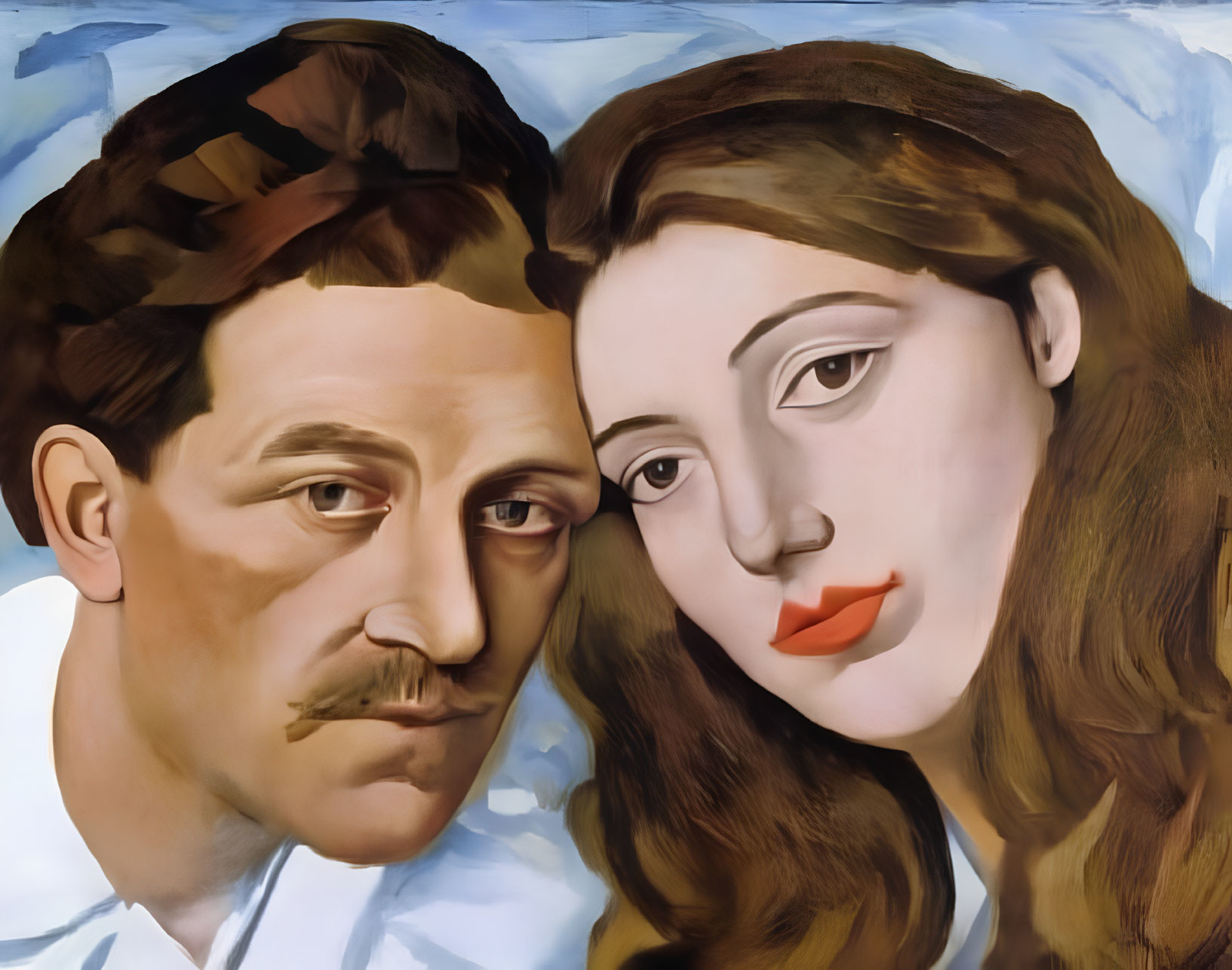
This striking digital portrait presents an intimate, almost mythic couple whose faces press together in quiet intensity against a swirling, abstracted sky of pale blues and whites. The man’s strong, angular features—deep-set eyes, prominent nose, and neatly trimmed mustache—are rendered with bold, planar simplifications, while the woman’s elegant profile features almond-shaped eyes, full vermilion lips, and flowing chestnut hair that cascades like a living wave. Their skin tones glow with warm ochres and pinks, yet the overall forms feel flattened and slightly fragmented, as though seen from multiple subtle angles at once. The composition merges the two heads into a single, harmonious unit, creating a powerful sense of emotional unity and psychological closeness.
The work consciously channels the revolutionary spirit of Cubism as pioneered by Pablo Picasso and Georges Braque in the years 1907–1914, when they shattered traditional perspective into interlocking geometric planes and simultaneous viewpoints. Here the faces are broken into simplified facets and strong contours that recall Picasso’s early portraits and Braque’s analytical still lifes, yet the fragmentation remains gentle and lyrical rather than aggressive. At the same time, the painting draws directly from Fauvism, particularly the liberated colour and expressive line of André Derain and Henri Matisse around 1905–1907. The woman’s vivid orange-red lips and the man’s sun-warmed flesh echo the Fauves’ fearless use of non-naturalistic hue to convey emotion and vitality, while the fluid, almost decorative background evokes Matisse’s joyous, pattern-rich interiors translated into an open-air setting.
Critically, the artwork achieves a rare and elegant synthesis of these two foundational early-modern movements. By tempering Cubism’s intellectual rigour with Fauvism’s sensual warmth, the artist avoids the cold geometry that can sometimes distance viewers from Cubist works and the potential decorative excess of pure Fauvism. The result is a portrait that feels both timelessly modern and deeply human—intimate without sentimentality, stylised without losing emotional truth. In an era when digital tools make such stylistic hybrids effortless, this piece stands out for its disciplined restraint and genuine poetic power, proving that the revolutionary lessons of Picasso, Braque, Derain and Matisse remain vibrantly alive.


