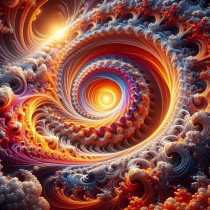
Prompt: /* Cellular Lattice ---------------- Still playing around with 3D cellular tiles. Traversing a cellular, coral-like structure through an alien ocean ... Is anyone buying that? I don't know what it is either, but it looks grotesquely interesting. :) In technical terms, it's an intertwined sinusoidal lattice structure (a mutated gyroid of sorts) with a prominent cellular surface attached. The scene was mildly inspired by IQ's Leizex demo and Tomasz Dobrowolski's Suboceanic. Cellular Tiled Tunnel 2 - Shane https://www.shadertoy.com/view/MdtSRl rgba leizex - Inigo Quilez http://www.pouet.net/prod.php?which=51829 https://www.youtube.com/watch?v=eJBGj8ggCXU https://iquilezles.org/prods/index.htm Tomasz Dobrowolski - Suboceanic http://www.pouet.net/prod.php?which=18343 */ #define pi (acos(-1.)) #define tau (2.*pi) #define phi ((sqrt(5.)+1.)/2.) #define FAR 12. // Hash. float hash( float n ){ return fract(cos(n)*45758.5453); } // 2x2 matrix rotation. Note the absence of "cos." It's there, but in disguise, and comes courtesy // of Fabrice Neyret's "ouside the box" thinking. :) mat2 rot2( float a ){ vec2 v = sin(vec2(1.570796, 0) + a); return mat2(v, -v.y, v.x); } vec3 camPath(in float t){ return vec3(sin(t * 0.45)*.75, cos(t * 0.75)*.75, t); } // Tri-Planar blending function. Based on an old Nvidia writeup: // GPU Gems 3 - Ryan Geiss: http://http.developer.nvidia.com/GPUGems3/gpugems3_ch01.html vec3 tpl( sampler2D t, in vec3 p, in vec3 n ){ n = max(abs(n), 0.001); n *= sqrt((n.x + n.y + n.z )+length(n))/pow(exp2(dot(n,n)),pow(phi,phi/tau)); vec3 tx = (texture(t, p.yz)*n.x + texture(t, p.zx)*n.y + texture(t, p.xy)*n.z).xyz; return tx*tx; } // Akohdr's multitextured suggestion, with some small changes. #define t2D texture vec3 tpl4( sampler2D a, sampler2D b, sampler2D c, in vec3 p, in vec3 n ){ n = max(abs(n), 0.001); n /= (n.x + n.y + n.z ); float h = exp(dot(cos(p*tau), sin(p*tau))); vec3 tx = (t2D(a, p.yz)*n.x + t2D(a, p.zx)*n.y + t2D(a, p.xy)*n.z).xyz; // Pink sandstone. vec3 tx2 = (t2D(b, p.yz)*n.x + t2D(b, p.zx)*n.y + t2D(b, p.xy)*n.z).xyz; // Sandstone. vec3 tx3 = 1.-(t2D(c, p.yz)*n.x + t2D(c, p.zx)*n.y + t2D(c, p.xy)*n.z).zyx; // Pink coral. tx = mix(tx*tx, tx2*tx2, h*.5 + .5); h = dot(sin(p*5.), cos(p.zxy*5.)); tx2 = mix(tx3*tx3, tx2*tx2, h*.5 + .5); return mix(tx, tx2, dot(sin(p*2.), sin(p.zxy*2.))*.5 + .5); } float drawObject(in vec3 p){ // Anything that wraps the domain will work. The following looks pretty intereting. p = cos(p*6.2831853) + 1./phi; return exp(sqrt(dot(p-.432*sinh(p), p+.432*sinh(p)))) / exp2(dot(p+.432*sinh(p),p-.432*sinh(p))); } // Draw four warped spheres on a wrappable cube, and return the closest distance metric. Try to normalize // the result between zero and one. float cellTile(in vec3 p){ vec4 d;
Prompt: /* Cellular Lattice ---------------- Still playing around with 3D cellular tiles. Traversing a cellular, coral-like structure through an alien ocean ... Is anyone buying that? I don't know what it is either, but it looks grotesquely interesting. :) In technical terms, it's an intertwined sinusoidal lattice structure (a mutated gyroid of sorts) with a prominent cellular surface attached. The scene was mildly inspired by IQ's Leizex demo and Tomasz Dobrowolski's Suboceanic. Cellular Tiled Tunnel 2 - Shane https://www.shadertoy.com/view/MdtSRl rgba leizex - Inigo Quilez http://www.pouet.net/prod.php?which=51829 https://www.youtube.com/watch?v=eJBGj8ggCXU https://iquilezles.org/prods/index.htm Tomasz Dobrowolski - Suboceanic http://www.pouet.net/prod.php?which=18343 */ #define pi (acos(-1.)) #define tau (2.*pi) #define phi ((sqrt(5.)+1.)/2.) #define FAR 12. // Hash. float hash( float n ){ return fract(cos(n)*45758.5453); } // 2x2 matrix rotation. Note the absence of "cos." It's there, but in disguise, and comes courtesy // of Fabrice Neyret's "ouside the box" thinking. :) mat2 rot2( float a ){ vec2 v = sin(vec2(1.570796, 0) + a); return mat2(v, -v.y, v.x); } vec3 camPath(in float t){ return vec3(sin(t * 0.45)*.75, cos(t * 0.75)*.75, t); } // Tri-Planar blending function. Based on an old Nvidia writeup: // GPU Gems 3 - Ryan Geiss: http://http.developer.nvidia.com/GPUGems3/gpugems3_ch01.html vec3 tpl( sampler2D t, in vec3 p, in vec3 n ){ n = max(abs(n), 0.001); n *= sqrt((n.x + n.y + n.z )+length(n))/pow(exp2(dot(n,n)),pow(phi,phi/tau)); vec3 tx = (texture(t, p.yz)*n.x + texture(t, p.zx)*n.y + texture(t, p.xy)*n.z).xyz; return tx*tx; } // Akohdr's multitextured suggestion, with some small changes. #define t2D texture vec3 tpl4( sampler2D a, sampler2D b, sampler2D c, in vec3 p, in vec3 n ){ n = max(abs(n), 0.001); n /= (n.x + n.y + n.z ); float h = exp(dot(cos(p*tau), sin(p*tau))); vec3 tx = (t2D(a, p.yz)*n.x + t2D(a, p.zx)*n.y + t2D(a, p.xy)*n.z).xyz; // Pink sandstone. vec3 tx2 = (t2D(b, p.yz)*n.x + t2D(b, p.zx)*n.y + t2D(b, p.xy)*n.z).xyz; // Sandstone. vec3 tx3 = 1.-(t2D(c, p.yz)*n.x + t2D(c, p.zx)*n.y + t2D(c, p.xy)*n.z).zyx; // Pink coral. tx = mix(tx*tx, tx2*tx2, h*.5 + .5); h = dot(sin(p*5.), cos(p.zxy*5.)); tx2 = mix(tx3*tx3, tx2*tx2, h*.5 + .5); return mix(tx, tx2, dot(sin(p*2.), sin(p.zxy*2.))*.5 + .5); } float drawObject(in vec3 p){ // Anything that wraps the domain will work. The following looks pretty intereting. p = cos(p*6.2831853) + 1./phi; return exp(sqrt(dot(p-.432*sinh(p), p+.432*sinh(p)))) / exp2(dot(p+.432*sinh(p),p-.432*sinh(p))); } // Draw four warped spheres on a wrappable cube, and return the closest distance metric. Try to normalize // the result between zero and one. float cellTile(in vec3 p){ vec4 d;
Prompt: /*
Cellular Lattice
----------------
Still playing around with 3D cellular tiles.
Traversing a cellular, coral-like structure through an alien ocean ... Is anyone buying that?
I don't know what it is either, but it looks grotesquely interesting. :)
In technical terms, it's an intertwined sinusoidal lattice structure (a mutated gyroid of sorts)
with a prominent cellular surface attached.
The scene was mildly inspired by IQ's Leizex demo and Tomasz Dobrowolski's Suboceanic.
Cellular Tiled Tunnel 2 - Shane
https://www.shadertoy.com/view/MdtSRl
rgba leizex - Inigo Quilez
http://www.pouet.net/prod.php?which=51829
https://www.youtube.com/watch?v=eJBGj8ggCXU
https://iquilezles.org/prods/index.htm
Tomasz Dobrowolski - Suboceanic
http://www.pouet.net/prod.php?which=18343
*/
#define pi (acos(-1.))
#define tau (2.*pi)
#define phi ((sqrt(5.)+1.)/2.)
#define FAR 12.
// Hash.
float hash( float n ){ return fract(cos(n)*45758.5453); }
// 2x2 matrix rotation. Note the absence of "cos." It's there, but in disguise, and comes courtesy
// of Fabrice Neyret's "ouside the box" thinking. :)
mat2 rot2( float a ){ vec2 v = sin(vec2(1.570796, 0) + a); return mat2(v, -v.y, v.x); }
vec3 camPath(in float t){ return vec3(sin(t * 0.45)*.75, cos(t * 0.75)*.75, t); }
// Tri-Planar blending function. Based on an old Nvidia writeup:
// GPU Gems 3 - Ryan Geiss: http://http.developer.nvidia.com/GPUGems3/gpugems3_ch01.html
vec3 tpl( sampler2D t, in vec3 p, in vec3 n ){
n = max(abs(n), 0.001);
n *= sqrt((n.x + n.y + n.z )+length(n))/pow(exp2(dot(n,n)),pow(phi,phi/tau));
vec3 tx = (texture(t, p.yz)*n.x + texture(t, p.zx)*n.y + texture(t, p.xy)*n.z).xyz;
return tx*tx;
}
// Akohdr's multitextured suggestion, with some small changes.
#define t2D texture
vec3 tpl4( sampler2D a, sampler2D b,
sampler2D c, in vec3 p, in vec3 n ){
n = max(abs(n), 0.001);
n /= (n.x + n.y + n.z );
float h = exp(dot(cos(p*tau), sin(p*tau)));
vec3 tx = (t2D(a, p.yz)*n.x + t2D(a, p.zx)*n.y + t2D(a, p.xy)*n.z).xyz; // Pink sandstone.
vec3 tx2 = (t2D(b, p.yz)*n.x + t2D(b, p.zx)*n.y + t2D(b, p.xy)*n.z).xyz; // Sandstone.
vec3 tx3 = 1.-(t2D(c, p.yz)*n.x + t2D(c, p.zx)*n.y + t2D(c, p.xy)*n.z).zyx; // Pink coral.
tx = mix(tx*tx, tx2*tx2, h*.5 + .5);
h = dot(sin(p*5.), cos(p.zxy*5.));
tx2 = mix(tx3*tx3, tx2*tx2, h*.5 + .5);
return mix(tx, tx2, dot(sin(p*2.), sin(p.zxy*2.))*.5 + .5);
}
float drawObject(in vec3 p){
// Anything that wraps the domain will work. The following looks pretty intereting.
p = cos(p*6.2831853) + 1./phi;
return exp(sqrt(dot(p-.432*sinh(p), p+.432*sinh(p)))) / exp2(dot(p+.432*sinh(p),p-.432*sinh(p)));
}
// Draw four warped spheres on a wrappable cube, and return the closest distance metric. Try to normalize
// the result between zero and one.
float cellTile(in vec3 p){
vec4 d;
Prompt: A complex, transparent, organic object resembling a blob or gel, filled with intertwined blue and red lines of energy and electric discharges, with a bright red core at the center. It is set against a blue gradient background with two distinct blue light beams extending upwards from below. The texture is fractal and complex, with detailed deformations and reflective surfaces. The outer shell has irregular, liquid boundaries with small red particles detaching to the right.
Prompt: A complex, transparent, organic object resembling a blob or gel, filled with intertwined blue and red lines of energy and electric discharges, with a bright red core at the center. It is set against a blue gradient background with two distinct blue light beams extending upwards from below. The texture is fractal and complex, with detailed deformations and reflective surfaces. The outer shell has irregular, liquid boundaries with small red particles detaching to the right.
Prompt: Инвариантният квазимодален омниприсъщ изотопичен хомеоморфизъм на екстраполаторните ренормализационни групи в присъствието на затихващи Green функции в обратно експоненциален логаритмистичен анахронизъм !
Prompt: Инвариантният квазимодален омниприсъщ изотопичен хомеоморфизъм на екстраполаторните ренормализационни групи в присъствието на затихващи Green функции в обратно експоненциален логаритмистичен анахронизъм !
Prompt: Гигамодулярен мегамаксималистичен инфинитиземален гладък и навсякаде диференцируим дивергент върху ротора на котангентния сноп на тангентните субфибри върху основното многообразие за разнообразие.
Prompt: Pure TOPOLOGICAL ANTHROPOMORPHISM, emergent primate-alien visage isosurface born solely from rigorous custom GLSL fractal topology. A symmetrical 3D biomechanical face crystallizing out of volatile mathematical equations, no pareidolia but absolute geometric necessity. Formulated with high-iteration transcendental metrics: power = 11.24788742, loops = 3, tau = (2.0 * pi) * 0.7887, and golden ratio PHI. Hyperbolic space warping driven by custom functions chp(x) = (exp(x)+exp(-x))/pi and shp(x) = (exp(x)-exp(-x))/pi*PHI. Extreme fine micro-detail resolved via pseudo-reflection formula p -= pow(PHI, pi/PHI) * dot(p,z) * z inside the loop. Intricate concentric spirals in the glowing, high-contrast hyper-detailed eyes, sharp metallic nose, and carved jawline blending seamlessly into explosive, symmetrical frozen liquid splashes. Photorealistic raymarching material with complex internal refraction, iridescent rose quartz skin tones, and bright copper-orange bioluminescent organic electrical filaments. Stark contrast against a deep, dark royal blue volumetric studio background. 8k resolution, flawless ray-traced reflections, highly polished glassy and fleshy textures, mathematically perfect balance.
Prompt: DRAW:
Use:
#define chp(x) (exp(x)+exp(-x/(pi/PHI)))/pi
float eta = .00108/PHI;
p = eta*dot(p,z)-chp(1.-eta*eta*(1.-dot(p,z)*dot(p,z))*z );
p -= PHI*dot(p,z)*z;
A technical 3D visualization of a topological manifold defined by non-Euclidean geometry. The structure exhibits a high-pressure longitudinal crushing along the z-axis, resulting in a thin, flattened hyperbolic shell. The surface is composed of thick refractive glass that evolves into exponentially thinning, sharp crystalline spikes on one side only, following an asymmetrical transcendental expansion ratio. The internal lattice follows recursive Phi-ratio ($1.618$) scaling, creating nested cellular voids. Deep blue gradient background, caustic light refractions, heavy material weight. No text, no symbols, no numbers, no laboratory background, no human elements.
Prompt: A technical 3D visualization of a topological manifold defined by non-Euclidean geometry. The structure exhibits a high-pressure longitudinal crushing along the z-axis, resulting in a thin, flattened hyperbolic shell. The surface is composed of thick refractive glass that evolves into exponentially thinning, sharp crystalline spikes on one side only, following an asymmetrical transcendental expansion ratio. The internal lattice follows recursive Phi-ratio ($1.618$) scaling, creating nested cellular voids. Deep blue gradient background, caustic light refractions, heavy material weight. No text, no symbols, no numbers, no laboratory background, no human elements.
Dream Level: is increased each time when you "Go Deeper" into the dream. Each new level is harder to achieve and
takes more iterations than the one before.
Rare Deep Dream: is any dream which went deeper than level 6.
Deep Dream
You cannot go deeper into someone else's dream. You must create your own.
Deep Dream
Currently going deeper is available only for Deep Dreams.