Prompt:
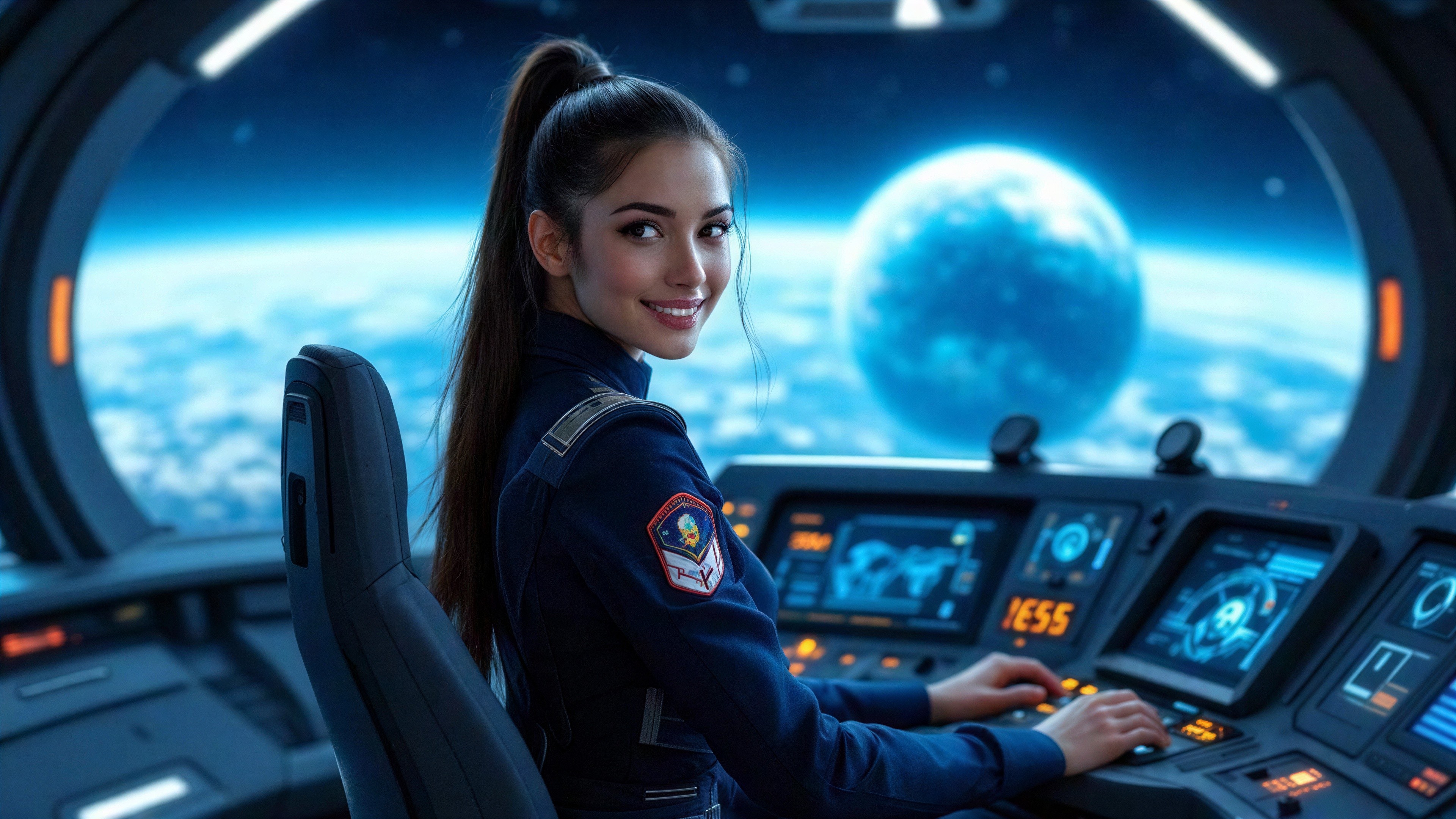
A young female starship officer is shown in a detailed three-quarters portrait, seated at a futuristic control console inside a high-orbit spacecraft. She turns slightly toward the viewer, looking back over one shoulder with a confident, warm smile that conveys intelligence, competence, and quiet pride. Her long dark hair is pulled into a high, disciplined ponytail, catching soft rim light along its edge. She wears a tailored deep-blue space uniform with structured seams, integrated tech panels, and embroidered mission patches, including a stylized planetary insignia and national markings, suggesting a near-future interstellar agency. Her posture is relaxed yet alert, one arm resting casually on the console while the other anchors her position at the controls.
The environment around her is a fully realized starship command deck. Curved walls and embedded displays glow with cool blues, teals, and amber interface lights. Transparent screens show navigational data, orbital readouts, and schematic overlays. Behind her, a wide observation window reveals a cosmic vista: a blue planet dominates the background, its cloud bands and continents clearly visible, accompanied by smaller moons suspended in deep space. Starfields stretch into the distance, reinforcing scale and isolation.
Material contrasts are crisp and intentional. The uniform fabric reads as advanced synthetic textile—matte, flexible, and durable—while the consoles combine brushed metal, glass, and illuminated circuitry. Skin tones are natural and lifelike, with subtle highlights on cheekbones and eyes. The color palette balances cool space blues and blacks with warm skin tones and soft golden interface accents, creating visual harmony and approachability.
Lighting is cinematic and controlled. Soft key light illuminates her face evenly, with gentle fill reducing harsh shadows. Cool ambient light from the displays wraps the scene, while faint planetary glow from the window adds depth. The atmosphere is calm, professional, and aspirational rather than tense.
The composition is eye-level and intimate, framed to keep the subject dominant while allowing the cockpit and planetary backdrop to contextualize her role. Depth is clearly layered: foreground figure in sharp focus, midground consoles readable, background space softly receding. The image reads as a heroic yet human portrait of near-future exploration.
--mod epic sci-fi portrait realism, --mod cinematic three-quarter view, --mod near-future space exploration, --mod high-detail character focus, --mod realistic human anatomy, --mod advanced space uniform design, --mod futuristic control room interior, --mod planetary backdrop through viewport, --mod balanced cool-warm color palette, --mod cinematic lighting, --mod ultra-detailed materials, --mod photorealistic rendering, --mod sharp focus foreground, --mod atmospheric depth, --mod aspirational science fiction tone, --mod AIVision-optimized color handling
More about On Watch
At the time, this image was unremarkable. A routine watch, a stable orbit, a junior
officer recorded in the margins of an otherwise ordinary mission log. The ship was
early in the sector, the charts incomplete, the jurisdiction provisional. Nothing in the
frame suggests authority. Nothing demands attention. That is precisely why it
endures.
Those who served with her later would say she always looked like this at the
controls—present, unhurried, already finished with the part of the job that required
uncertainty. The systems were steady. The planet was where it was supposed to be.
The watch continued. She did not pose, and she did not imagine herself being
remembered. She was exactly where she belonged, doing exactly what the moment
required.
When the sector was formalized, when the routes were named and defended, when
command finally caught up to reality, this photograph resurfaced without
commentary. No annotation was necessary. It was simply understood that she had
been there from the beginning—not to witness history, but to keep it running
correctly while it decided what to become.

 Artist