

Comments
Loading Dream Comments...
You must be logged in to write a comment - Log In
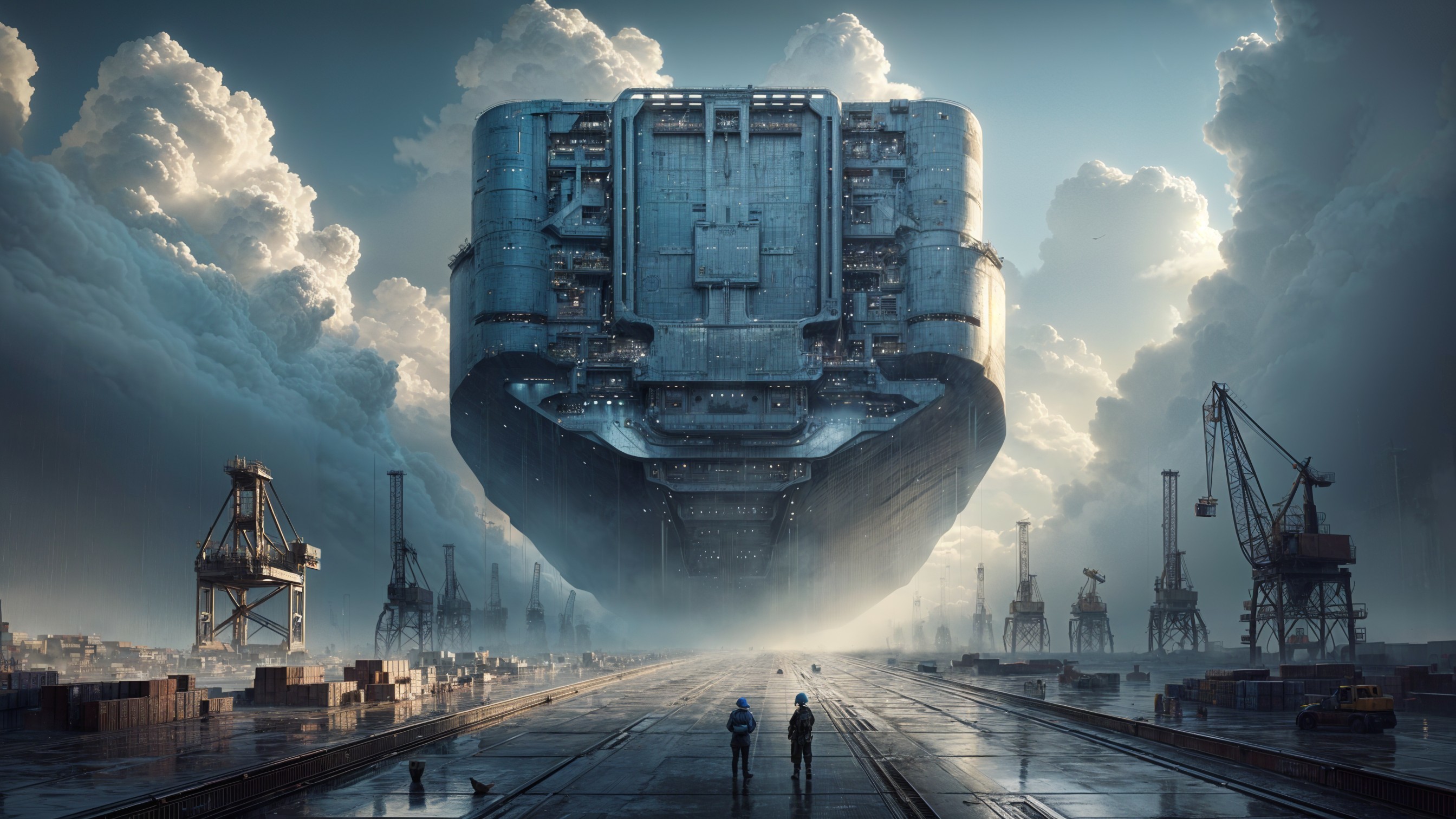
A colossal sky‑freighter hovers inches above a rain‑slicked industrial ocean dock, its armored blue hull filling most of the frame as downwash from its thrusters scours mist and grit across the platform. Two dock workers in hard helmets stand in the wet foreground mid‑conversation, their small human scale brutally contrasted against the airborne leviathan as gantry cranes, scaffold towers, and cargo superstructures recede into atmospheric haze. The freighter’s surface is scarred with accumulated service wear—abrasion streaks, oil blooms at gasket seams, grime trapped along panel breaks—broken by broad white identification stripes and massive stenciled hull characters. Recessed thruster bells glow cold blue as vapor curls backward under load, the force of lift made visible in streaming fog and rippling puddle reflections. Behind the primary vessel, additional cargo haulers drift through stacked cloud layers along an established aerial shipping corridor, their silhouettes softened by depth haze. Vast cumulus banks are pierced by late‑day sunbeams that rake across steel, vapor, and water in disciplined shafts of light. The soaked dock mirrors sky, machinery, and motion in fractured reflections while faint wind turbines line the far horizon beyond the port. Extreme scale contrast dominates the composition: routine labor rendered dignified beneath monumental infrastructure. The mood is industrial awe without spectacle—massive power normalized through repetition—capturing a working future observed in a quiet, operational moment rather than a crisis. --mod epic cinematic sci‑fi realism, --mod ultra‑wide low‑angle composition, --mod extreme scale contrast, --mod grounded industrial futurism, --mod volumetric cloud lighting, --mod disciplined atmospheric depth haze, --mod high dynamic range lighting, --mod photoreal hard‑surface engineering detail, --mod beveled composite plating, --mod service scuffs and oil blooms, --mod reflective rain‑soaked concrete, --mod layered vapor and thruster downwash, --mod environmental storytelling, --mod cinematic color grading, --mod sharp foreground fidelity with depth falloff, --mod aerial traffic as scale witness, --mod maritime megastructure infrastructure
The vessel’s designation never appeared on civilian registers, and only later did
analysts understand why. At full displacement, the vessel exceeded the mass-
handling limits of most orbital yards, rendering standard documentation
meaningless. It was classified instead by function: a deep-haul transfer platform
designed to move singular cargoes whose value—or danger—made redundancy
impractical. The hull was built outward from the containment volume, not inward from
propulsion, resulting in a form that seemed less like a ship than a mobile drydock.
Port authorities along the route recorded no docking requests. The vessel did not
arrive so much as impose presence, suspending operations across entire harbors by
the simple fact of its shadow.
Witnesses on the ground often mistook the delivery itself for the cargo, unable to
comprehend that anything could be inside something of that scale. They were
wrong. TTA records indicate that the true payload was never visible, never unloaded
in public view, and never discussed outside of closed review panels. The ship
remained grounded only long enough to complete transfer verification, then departed
without ceremony, leaving behind reinforced pavement, revised safety margins, and
a generation of engineers who would quietly recalibrate their understanding of what
“transport” could mean. In later years, Special Delivery would be cited not for what it
carried, but for what it demonstrated: that when something must arrive intact,
distance and proportion cease to be constraints—they become requirements.


