Comments
Loading Dream Comments...
You must be logged in to write a comment - Log In
 Artist
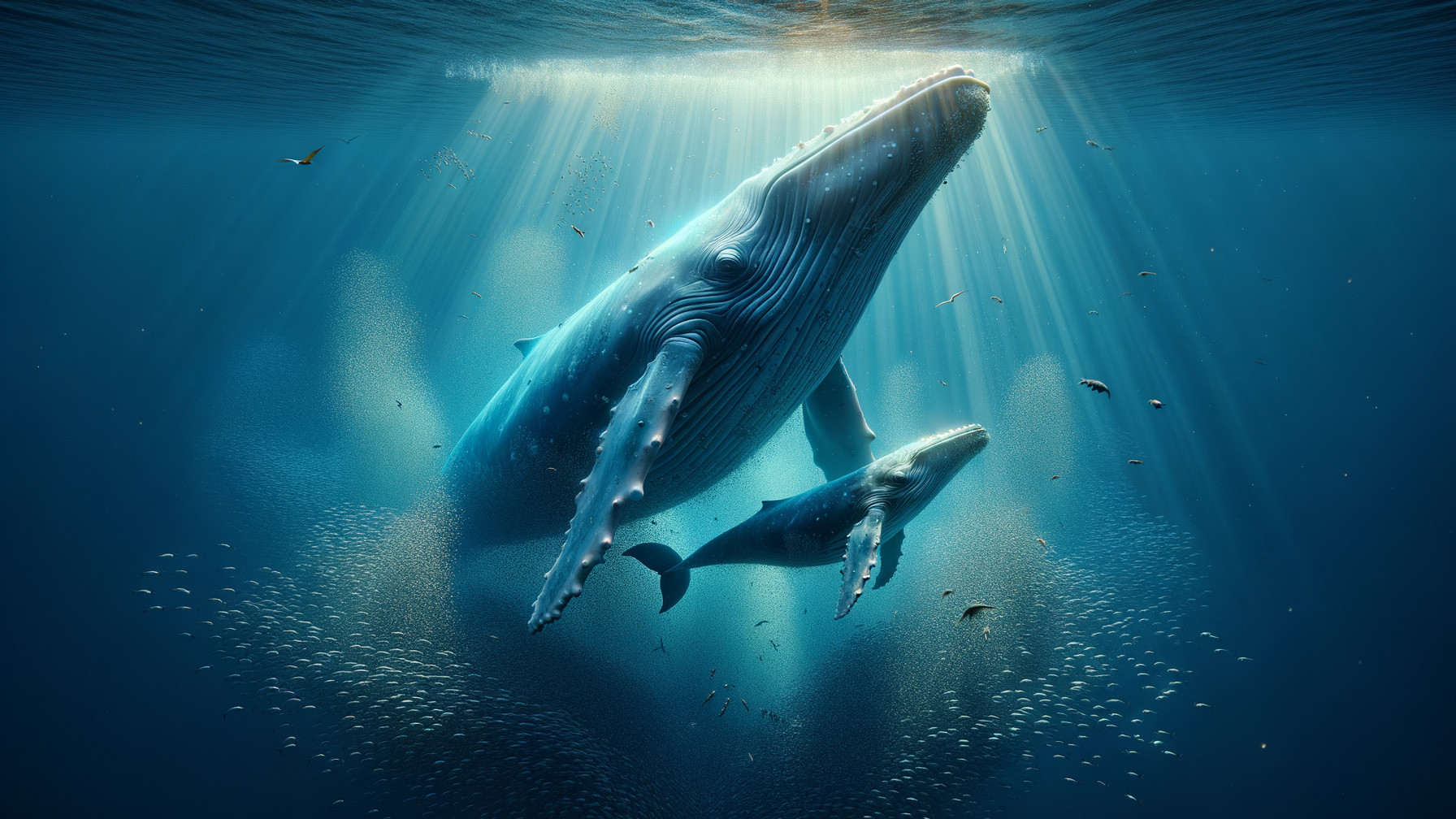
Create an awe-inspiring hyperreal 3D underwater panorama of a blue whale mother and calf rising toward filtered sunlight in deep blue water. Composition: wide-angle upward view from below; calf partly alongside mother, bubbles and krill cloud visible. Lighting: volumetric sunbeams piercing deep water, particulate light scattering, subtle caustics on whale flanks. Texture & detail: skin mottling, barnacle scars, baleen close-up detail, water micro-bubbles, krill swarm as ecosystem detail. Palette: deep cerulean to ultramarine gradation, pale underbelly creams, sun-bleached highlights. Depth & 3D: pronounced depth with particle volumetrics, realistic water attenuation; foreground krill swarm slightly out of focus for scale. Style-mix options: oceanic romanticism in the spirit of Turner for light + modern photorealism for skin detail; or stylized mural with Klimt-ornamental patterns subtly layered into krill cloud. Camera: ultra-wide 24mm feel; output for large-format mural and planetary dome projection. Variations: breaching surface view, skeleton / paleontology study for “past meets present” exhibit. Mood: cosmic, elegiac, sublime. RY
**Blue Whale
Scientific name: Balaenoptera musculus
Typical lifespan: 70–90+ years (estimated).
Gestation: ~10–12 months.
Diet: Filter-feeder- krill and small schooling crustaceans.
Role in nature: Oceanic ecosystem giants - nutrient cycling via fecal plumes (fertilize phytoplankton), influence carbon sequestration.
Range / countries: Circumglobal in deep oceans; migration between polar feeding grounds and temperate/tropical breeding grounds.
Size / length: Up to ~24–30+ m (longest known specimens ~30 m).
Weight: 100-200+ metric tons.
Bite force: Not applicable — baleen filter feeders (no biting).
Vision / hearing: Good low-light vision underwater; acute low-frequency hearing for long-range communication.
Abilities: Long-range migration, deep foraging lunge feeding, low-frequency song/communication across hundreds of km.
Conservation: Endangered in many regions - historic whaling reduced numbers; recovery slow.
Extra: Largest animal known to have lived on Earth.
2025 August 26