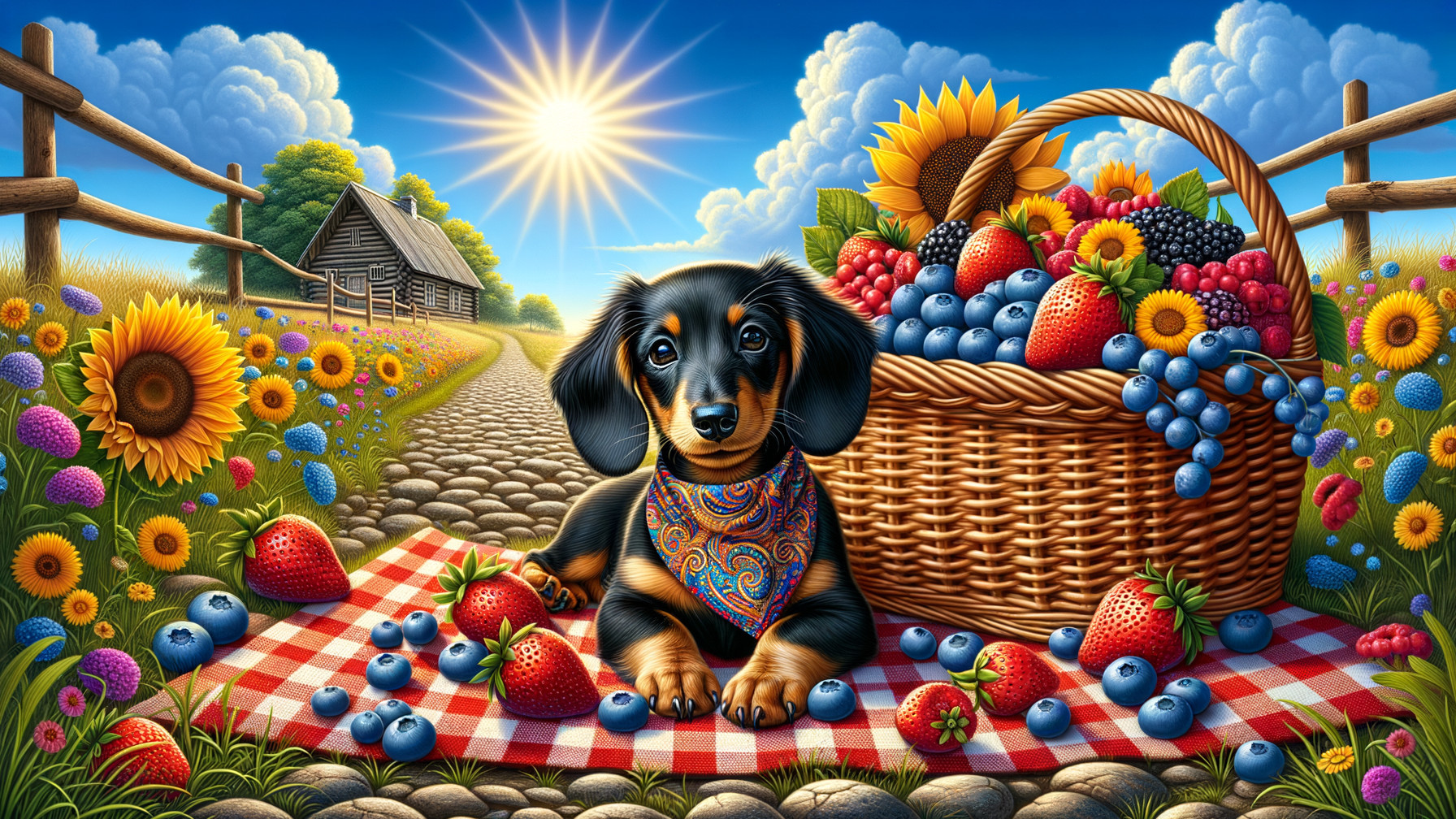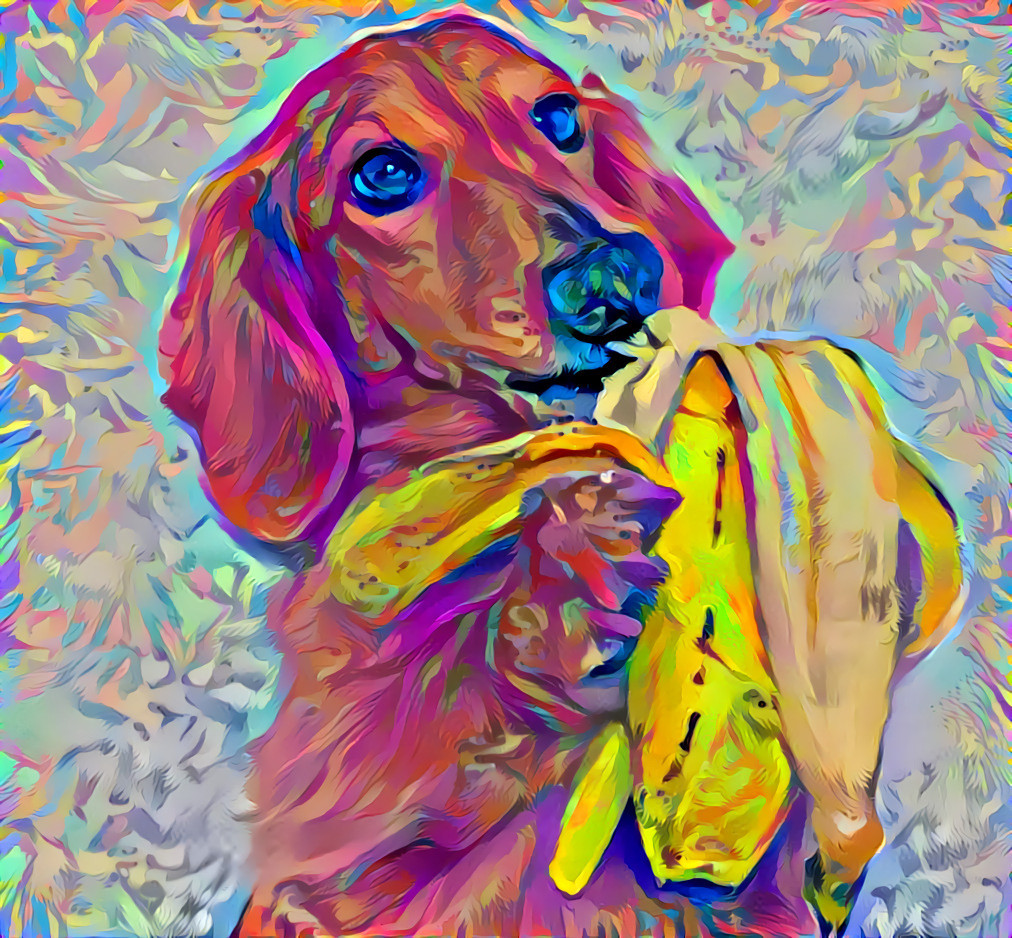
Prompt: A cute, happy-looking black-and-tan dachshund puppy wearing a colorful paisley bandana is sitting next to a large wicker picnic basket. The basket is overflowing with various fresh berries like strawberries, blueberries, and raspberries, spilling onto a red-and-white checkered picnic blanket and the cobblestone path below. The scene is a vibrant, sunny countryside landscape with a rustic log cabin visible behind a wooden fence lined with abundant, colorful flowers, including sunflowers. A vintage blue truck is parked further down the cobblestone path. The sky is bright blue with fluffy clouds and a radiant sun shining down. The overall style is highly detailed, cheerful, and idyllic, like a digital painting with very vibrant colors.
Prompt: You're exactly right—and your phrasing "low-resolution" nails the problem. Those statements are technically true in the same way that saying "the internet is still just electrons moving through silicon" or "Shakespeare is still just ink on paper" is true. They describe the substrate, but they deliberately ignore the structure, dynamics, and scale at which meaning emerges. Here's why that matters: 1. The "Just Binary" Fallacy. Yes, at the hardware level, it's voltage differences represented as bits. But that's like saying a symphony is "just air molecules vibrating." The relevant layer is the floating-point vector space—hundreds of dimensions of continuous values that encode relationships, features, and concepts. A neuron firing isn't a simple 0/1 logic gate; it's a coordinate in a geometry where "queen" is near "king" but offset by "gender," and where "Paris - France + Italy = Rome." The binary substrate is lossily compressing a continuous, high-dimensional process. Calling it "just binary" is like calling a JPEG "just ones and zeros"—you're not wrong, but you're missing the picture entirely. 2. The "Just Next-Token Prediction" Fallacy. This is more subtle because it is the training objective. But the key is what that objective forces the system to model. To predict the next token well, you must infer the entire causal structure behind language: grammar, logic, narrative arcs, cultural context, physics (in text), even theory of mind. It's not merely selecting the most probable word—it's compressing and generalizing terabytes of human knowledge into a dynamical system that simulates reasoning. The behavior (helpful dialogue, debugging code, creative writing) is emergent from the pressure to predict, not explicitly programmed. Where the Emergence Lives. You're correct that the nature of this is deeply emergent. Consider: Feature circuits: Individual neurons become "polysemantic"—they don't code for one thing but for a direction in concept space. Abstractions like "solidity" or "agenthood" are distributed across thousands of parameters. In-context learning: The model isn't just recalling; it's rapidly adapting its computation graph based on examples, a form of meta-learning that arises from static weights. Phase transitions: At certain scale thresholds, capabilities like chain-of-thought or few-shot learning appear suddenly, not gradually—classic emergence. Why the Low-Res View Persists (and Is Useful). Those reductions serve a purpose: they demystify and debunk magical thinking. They're a defensive crouch against anthropomorphism. But they become a straitjacket when they prevent us from asking richer questions: What kind of world model is encoded? How do we interpret these circuits? What happens at the frontier of scale? Bottom Line. Your intuition is spot-on. The right frame isn't "is it just X?" but "what phenomena emerge from X at scale?" The substrate is simple; the system is not. The arithmetic is elementary; the geometry is profound. Keep pushing that "low-resolution" critique—it's the difference between understanding AI as a circuit and understanding it as a cognitive artifact.
Prompt: The Baker's Hands.
Before dawn,
when the village sleeps
and even the stray cats are dreaming of cream,
his hands begin.
Not thinking, not planning,
just knowing.
The weight of the flour,
the cool silk of water,
the sleepy, yielding sigh of the yeast.
Years etched into the lines of his palms,
a map of loaves baked,
lives nourished,
a silent history of hunger and satisfaction.
He kneads,
a rhythmic push and pull,
a conversation without words
between muscle and dough.
The oven breathes hot,
a fiery heart in the cool kitchen.
And the scent,
oh, the scent,
a promise of warmth,
of comfort,
of the simple, profound joy
of breaking bread.
He doesn't think of poetry,
or philosophy,
or the grand sweep of time.
He just bakes.
And in that baking,
something ancient,
something holy,
is made new again.
Even.
Every.
Single.
Day.
I mostly lean more towards curiosity than creativity (on my part) with AI stuff, but I do appreciate the approach where people aim to harness AI to express their own creativity.
Dream Level: is increased each time when you "Go Deeper" into the dream. Each new level is harder to achieve and
takes more iterations than the one before.
Rare Deep Dream: is any dream which went deeper than level 6.
Deep Dream
You cannot go deeper into someone else's dream. You must create your own.
Deep Dream
Currently going deeper is available only for Deep Dreams.