
Comments
Loading Dream Comments...
You must be logged in to write a comment - Log In
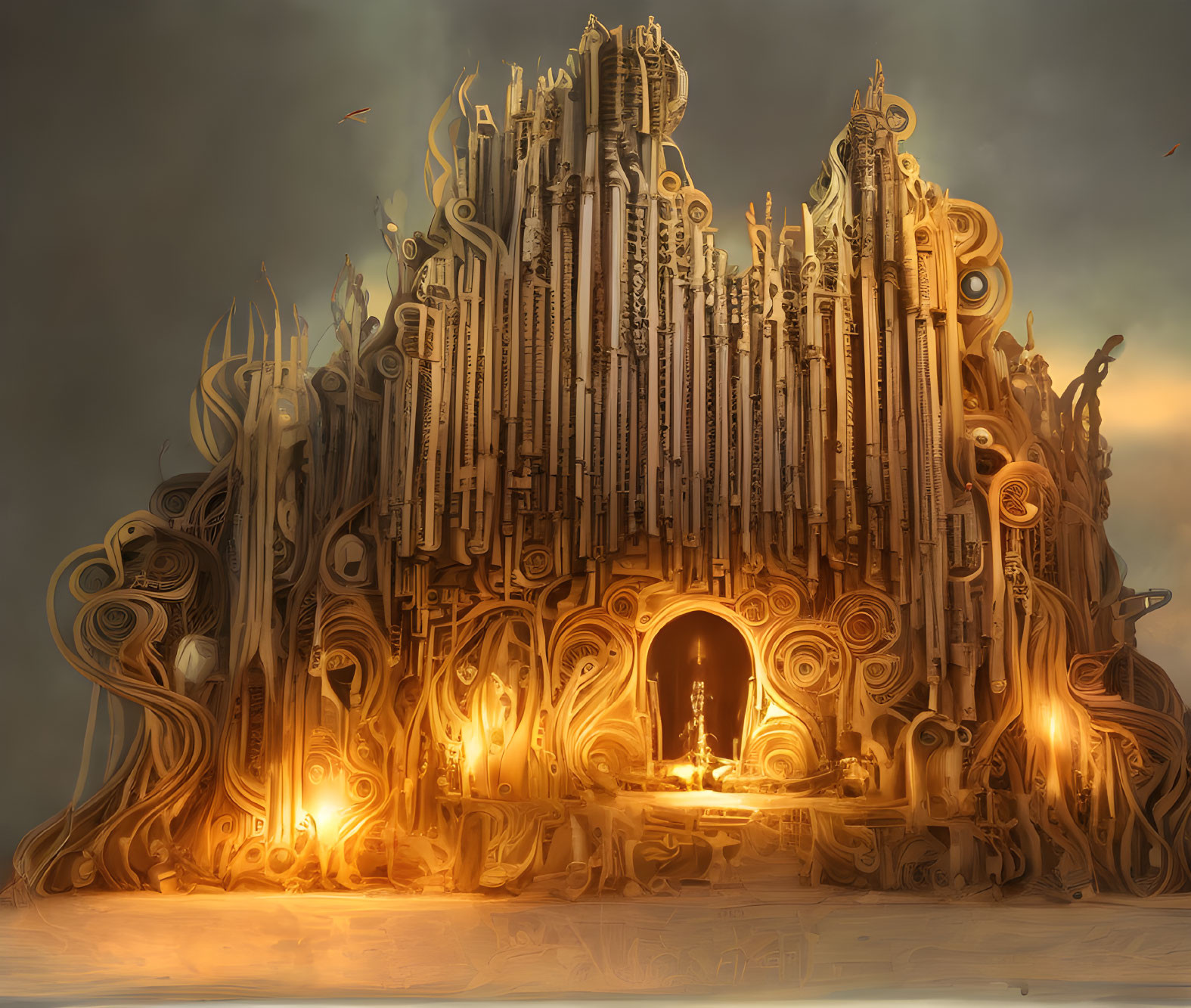
Landscape. Pipe organ. Octopus. H. R. Giger. Stipling.
This piece exemplifies the marriage of H.R. Giger's biomechanical aesthetic with landscape painting, creating a monumental structure that exists somewhere between cathedral, organism, and industrial machine. The central pipe organ element—rendered as towering vertical pipes that dominate the composition—serves as the spine of an architectural form that appears to be simultaneously growing and constructed. The artist has employed stippling and intricate linework to create a hypnotic surface texture that suggests both weathered metal and living flesh, a duality that sits at the heart of Giger's visual language. The warm golden-orange palette, punctuated by the incandescent glow emanating from the central opening, prevents the piece from descending into the cold, sterile darkness typically associated with biomechanical work, instead infusing it with an almost sacred luminosity.
The octopus influence emerges in the organic, tentacular forms that writhe around and through the structure—particularly evident in the sinuous, curved elements flanking the composition on both sides. These appendages create a sense of movement and vitality that counterbalances the rigid geometric precision of the pipes and architectural framework. The stippled technique is masterfully applied here, with thousands of minute marks building form and shadow, creating an almost obsessive quality that demands close viewing. The depth of field is exceptional; the foreground's sandy wasteland grounds the viewer in scale, while the grey sky and distant horizon establish the piece as a genuine landscape rather than merely a floating object.
However, the composition risks becoming visually overwhelming in its density. While the stippling technique is admirably executed, there are moments where it obscures rather than clarifies form, particularly in the mid-tones where contrast becomes muddied. The integration of the octopus elements, though conceptually compelling, occasionally feels tangential to the organ/architecture narrative rather than fully synthesized. Despite these minor critiques, this is a work of genuine imaginative scope—it presents a believable yet impossible world, one that manages to feel both menacing and mysteriously inviting through that golden door.


