Comments
Loading Dream Comments...
You must be logged in to write a comment - Log In
 Artist
Before AI learned to dream for us, there was a stranger, slower art called Holographic Glossolalia—a pre-AI method of reverse image generation. Practitioners believed every photograph contained its own hidden language: textures muttering verbs, reflections whispering forgotten nouns, shadows reciting broken hymns. The artist’s task wasn’t to add anything, but to listen until the image confessed what it had been holding back.
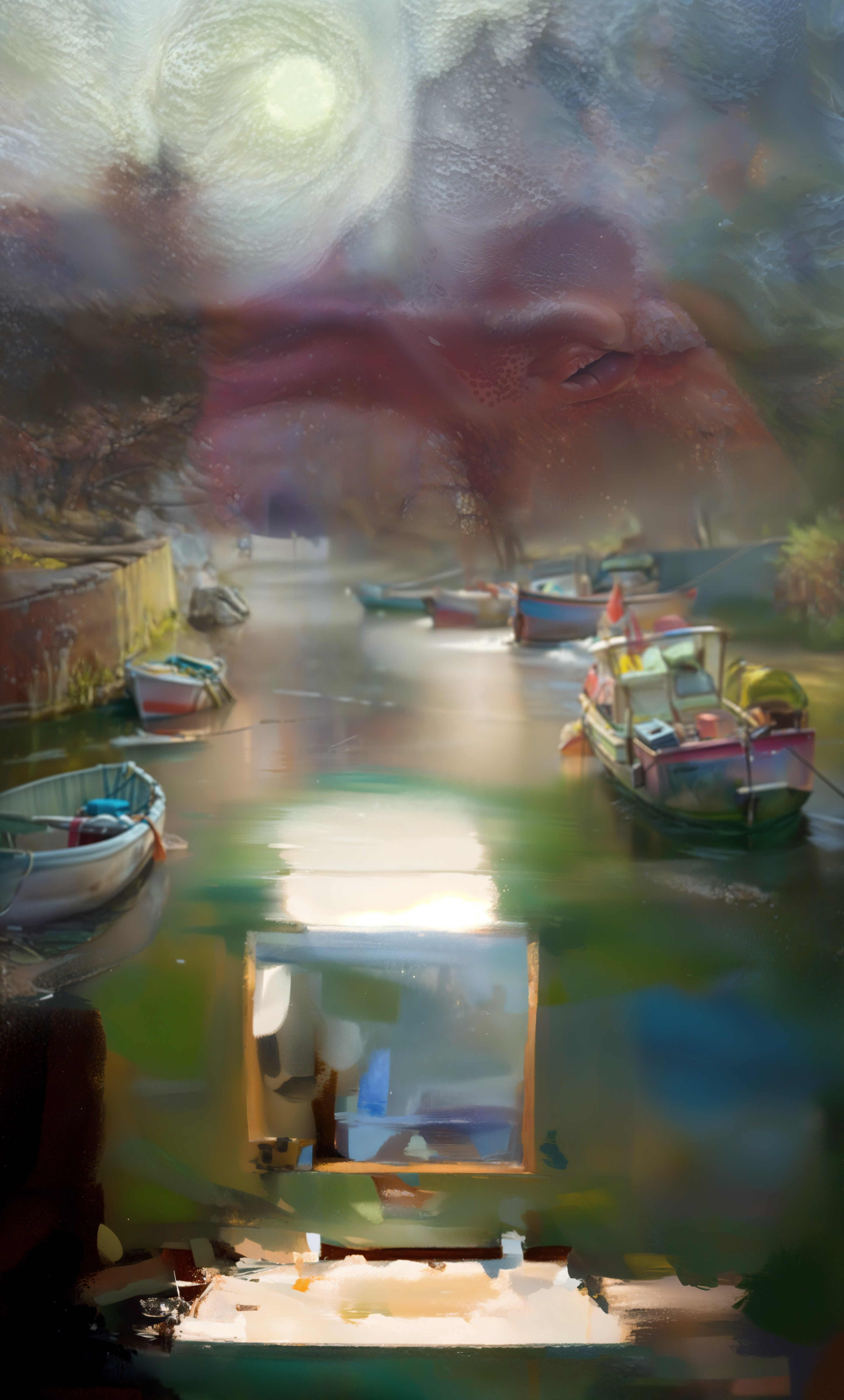
The process always began with something ordinary—a canal at dusk, a handful of fishing boats, a soft churn of water. The artist stared until the picture trembled, until light bent at an impossible angle. This moment, called the “holographic sway,” signaled that the photograph’s internal grammar was loosening, its unspoken memories rising to the surface.
Then the reverse generation began.
Holographic Glossolalia didn’t collage outward—it peeled inward. Artists separated the image into the unrealized possibilities lurking beneath it. The moon that wasn’t photographed but was somehow implied. The ghostly face forming in the sky as if the world itself were having a dream. The submerged window reflecting a room that never existed, yet had always been waiting inside the water’s memory.
Nothing was invented; everything was revealed.
In this piece, the canal speaks in layered dialects. The boats drift in the main narrative of the surface world, but beneath them, the water releases a domestic memory—a luminous window opening into a half-erased interior life. Above it all, a vast face emerges from swirling cloud textures, the hidden observer whose inward breath ripples the scene like a soft tide.
Glossolalia artists believed images behaved like oracle bones. If you heated them with enough attention, they cracked open, revealing timelines, emotions, and dream residues the photograph had absorbed but never shown.
The technique vanished when AI arrived, when machines learned to generate images directly without listening to their ghosts. Yet those who practiced Holographic Glossolalia insist its spirit survives. Look long enough at any picture, and you can still feel the old murmuring: the world reverse-generating itself through a swirl of light, a face in the clouds, or a window glimmering in the water.
A reminder that long before algorithms, images already spoke in tongues—
we just had to learn how to hear them.