Comments
Loading Dream Comments...
You must be logged in to write a comment - Log In

 Artist
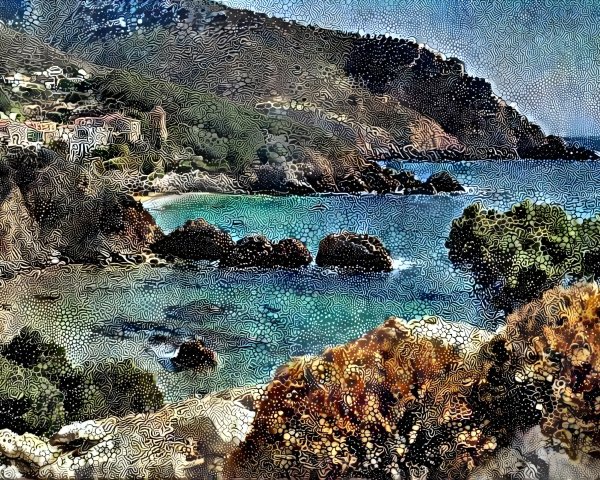
They say Playa de las Cavernas Errantes changes shape at night, that the two great limestone arches inhale the tide like ancient lungs. I didn’t believe any of that, of course—not until I met Rafito el Varado, the beach bum who had apparently been stranded on this stretch of the Rivera since the late ’70s without aging a day. He lounged there every morning under the leaning shadow of the left arch, wearing a sun-bleached hat the color of evaporated dreams, always ready to explain his latest surreal misadventure with the casual tone of someone describing yesterday’s weather.
He told me the beach hadn’t been a beach at all the previous evening.
“Last night it was a library,” he said, brushing sand from his bookless hands. “The waves were whispering footnotes.”
I didn’t question him. Not here. Cavernas Errantes had that effect: it made skepticism feel like an unfashionable coat.
According to Rafito, at sunset the rocks rearranged their geometry so he could walk into the larger arch and come out somewhere completely different each time—once into a jazz club in Nice in 1954, another time into a child’s dream about a mechanical seahorse. Sometimes he returned carrying things impossible to verify: a matchbook from a city that never existed, the smell of absinthe, or a tune hummed by someone who wasn’t quite human.
By midday he’d wander the sand, drifting like a philosopher struck by heatstroke, debating with invisible interlocutors about whether the sea was a metaphor for history or vice versa. His arguments were compelling, mostly because the water actually changed color as he spoke—teal when he was confident, emerald when he doubted himself.
One afternoon he invited me to join him on what he called “a minor dérive with major implications.” We walked into the smaller cave at low tide. Inside, the air felt like it had been exhaled by an extinct animal. Rafito tapped the rock wall three times. The cave trembled lightly, as if remembering something. Then the exit behind us flickered, and for a moment we saw a completely different shoreline—moonlit, volcanic, uninhabited except for a figure in the distance waving at us with too many arms.
“No, no,” Rafito sighed, “I’ve been there. Terrible espresso.”
The vision snapped shut like a curtain, and we were back in the warm Sunday hush of Cavernas Errantes. Rafito shrugged, as though reality’s elasticity was a mildly inconvenient feature of the property.
We sat on the sand afterward, watching the turquoise water fold itself into improbable forms. Rafito said the beach only revealed its secrets to those who slept on it without expectation. But he never slept—claimed dreams were too unstable a currency.
When I left at dusk, he was still there, half-shadowed, half-legend. He waved, though I wasn’t sure if the gesture was meant for me or for whatever alternate shoreline was briefly shimmering behind me.