
Comments
Loading Dream Comments...
You must be logged in to write a comment - Log In
 Artist
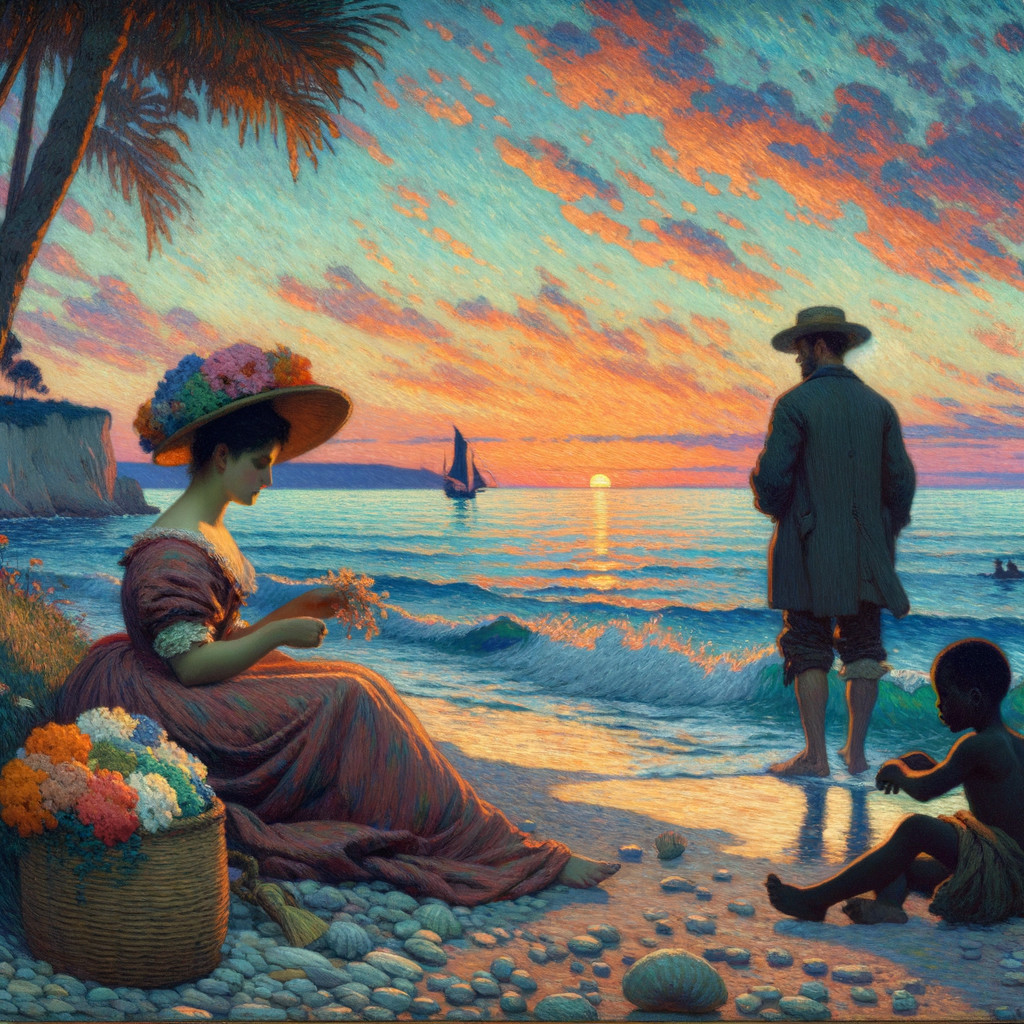
Create a high-resolution, painterly digital image that evokes Paul Gauguin’s Tahitian Synthetist style — NOT a copy of a specific painting but a new composition using his visual language. Scene: a tranquil shoreline at dusk with three local figures arranged in a triangular composition: one seated woman in profile weaving flowers, a reclining man looking toward the sea, and a child playing with a shell near the water. Composition & perspective: shallow picture plane (flattened depth), moderate low-angle vantage so figures sit against a flattened banded horizon; strong silhouette shapes and clear negative space. Color & palette: non-naturalistic, saturated palette — deep cadmium orange, viridian green, ultramarine-blue twilight, warm ochre, and a touch of rose/magenta for flesh accents; large flat color blocks with subtle tonal modulations. Line & form: use thick, dark contour lines to separate forms (cloisonné effect); simplify anatomy into elegant planar shapes but keep convincing weight and posture. Brushwork & texture: broad, blocky brush strokes for landscape and garments; slightly chalky, matte paint surface; visible paint edges and occasional palette-knife scoring; varnish simulated as satin—not glossy. Light & atmosphere: warm late-dusk ambience with decorative sun-glow bands behind the horizon; reflections rendered as patterned color bands, not photoreal highlights. Symbolic details: include symbolic motifs — a small carved tiki, a bird perched on a branch, a simple cross half-submerged — integrated subtly to suggest mythic narrative. Patterning: incorporate flat decorative patterns in background foliage and simple textile motifs on garments. Render finish: painterly 4k canvas look with slight canvas grain and hand-painted imperfections (brush drag marks, scumble). Camera & output: full canvas aspect (3:4 or 4:5), high-resolution TIFF/PNG suitable for printing; provide a cropped square social variation focusing on the central seated figure. Variations: (A) woodcut/linocut study with high-contrast blacks and a limited two-color palette; (B) twilight palette swap—replace orange with deep crimson for a more dramatic mood. Artistic notes: avoid photoreal skin smoothing—retain painterly texture and visible strokes; emphasize decorative flatness while keeping figure solidity.
**Paul Gauguin (1848–1903)
# France (worked extensively in Tahiti)
Paul Gauguin was one of the most restless and iconoclastic artists of the late 19th century: a former stockbroker turned painter who deliberately left Western conventions behind to search for a more direct, symbolic language of color and form. Frustrated with Impressionism’s fleeting effects, he developed Synthetism and often worked in what critics call cloisonnist ways flattening space, outlining shapes, and using broad, decorative fields of color to convey mood and myth rather than literal light.
Gauguin’s Tahiti period (from 1891 onward) fused exoticized island subject matter with intense personal symbolism: ritual scenes, reclining figures, and enigmatic compositions that read like visual poems.
His paintings deliberately reject photographic naturalism skin might be painted green or violet, backgrounds become patterned planes, and symbolic objects (flowers, crosses, birds) anchor a private cosmology. While his work is visually intoxicating- bold color, flattened perspective, and carved silhouettes -it’s also complex and controversial: the images reflect colonial dynamics, mythmaking, and Gauguin’s self-mythology.
Ultimately, his legacy is a style that privileges emotional truth and archetypal imagery over imitation of nature.
Recommended From @Terrynew
(Thank you Terry For recommending this amazing Artists.)
- Rojitha Yasaswin
2025 August 20


