
Comments
Loading Dream Comments...
You must be logged in to write a comment - Log In
 Artist
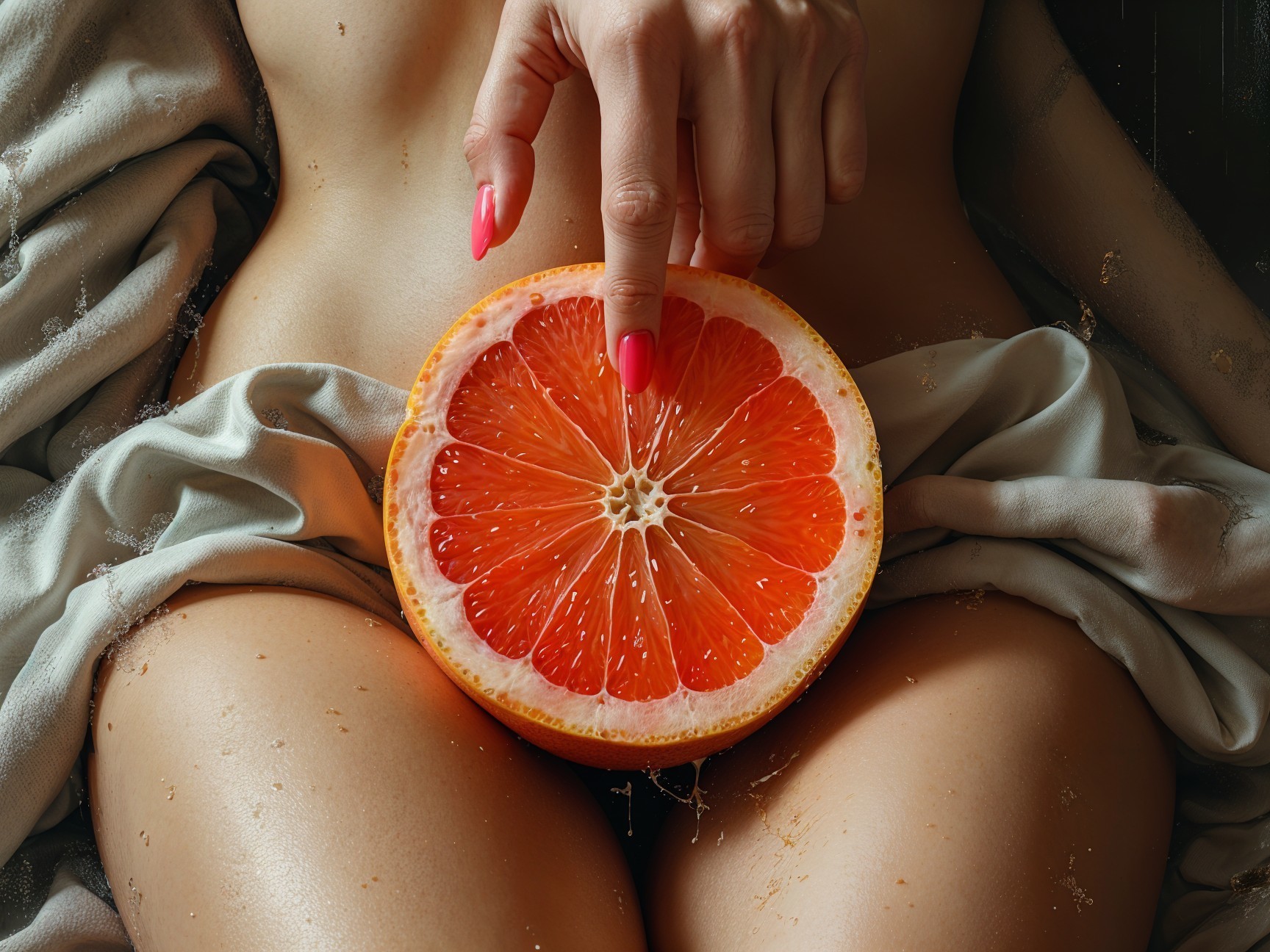
A raw, high-contrast mixed-media composition blending figurative realism with abstract visual tension. At the center, a female figure’s lower body is framed from the waist to mid-thigh, seated or reclined upon soft, folded fabrics in muted beige (Pantone 468 C) that dissolve into painterly blurs. Resting at the base of her thighs lies a halved grapefruit, its vibrant pulp exposed in a vertical cut — glowing with deep coral-pink (Pantone 1775 C) and sun-warmed orange tones (Pantone 1645 C). The fruit’s surface gleams with moisture, each droplet rendered in translucent pearl highlights (Pantone 663 C) that catch the surrounding light. From above, a delicate hand reaches toward the fruit — fingertips with vivid neon coral nail polish (Pantone 1788 C) tracing gently along the central cut of the grapefruit. The gesture is poised yet tender, both symbolic and serene, as though exploring the fragile boundary between organic life and sensory experience. The composition is washed in soft, cinematic lighting, the skin tones rendered in warm golden hues (Pantone 7559 C) contrasted against deep shadow gradients of taupe gray (Pantone 403 C). Expressive abstract textures bleed outward from the central focus — splashes, blurred edges, and gestural brushwork in carbon black (Pantone Black 6 C) and dusty rose undertones (Pantone 7608 C) — giving the piece its kinetic, emotional pulse. The result is an intimate yet conceptual image — a visual metaphor of touch, perception, and vulnerability, where the organic fruit becomes an emblem of vitality and sensual awareness rather than literal depiction. The atmosphere feels alive with movement, light, and quiet introspection — balancing restraint and intensity in one striking frame.
The Purity of Pleasure — Reclaiming the Right to One’s Own Body
For too long, the human body has been viewed through a distorted moral lens — one that equates desire with danger, and pleasure with impurity. This is not an instinctive human truth, but a cultural construction, born largely from the moral codes of monotheistic religions that sought to regulate the most intimate aspects of life. These systems, while historically influential, have left a deep psychological imprint: a quiet, persistent shame toward one’s own physicality.
Modern science and psychology have decisively dismantled that stigma. The human sexual response — including self-touch and mutual touch — is not an indulgence, but a biological and psychological expression of health. Medical research confirms that masturbation and other non-harmful forms of sexual self-expression help regulate stress hormones, improve mood through endorphin release, promote better sleep, and increase body awareness. Within the context of consent, safety, and emotional integrity, these gestures represent not moral weakness but self-knowledge — an affirmation that one’s body is a source of comfort, not of guilt.
The suppression of sexuality has always served institutions more than individuals. A body made to feel ashamed is a body that can be controlled. When societies teach people to distrust their own sensations, they fracture the unity between body and mind — a unity essential to mental and emotional well-being. To reclaim pleasure, therefore, is to reclaim autonomy: to say that one’s physical being belongs not to dogma, but to oneself.
To call masturbation “impure” or “sinful” is to misunderstand the very nature of life. There is nothing corrupt about the human instinct to explore, to feel, to connect with oneself. These acts are as ancient as breath, as universal as thought. They are moments of reflection and grounding — small, private rituals through which people rediscover that their own skin is not a prison, but a home.
The time has come to free the body from inherited shame. The language of sin should never dictate the boundaries of science or the experience of joy. To touch oneself or another with care, curiosity, and respect is not a transgression; it is a declaration that being human means being whole — flesh and spirit, instinct and intellect, united in the same act of self-recognition.
Pleasure, in its purest form, is not the enemy of virtue. It is the proof of life itself.


