


Comments
Loading Dream Comments...
You must be logged in to write a comment - Log In
 Artist
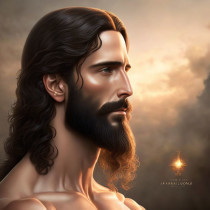
Jesus The The God Cube Tesseract
Tesseracts and the Concept of God
The intersection between the geometric tesseract and the divine is often used in art, philosophy, and theology as a metaphor for how a higher, unseen reality interacts with our physical world:
I Release You of The Spell . . .
Salvador Dalí’s Crucifixion (Corpus Hypercubus): Dalí painted Jesus on an unfolded net of a tesseract rather than a traditional wooden cross. The 4D hypercube serves as a geometric symbol for the transcendental nature of God—existing in dimensions or a realm that is completely invisible and incomprehensible to the human mind, much like a 4D shape is to 2D or 3D beings.
• Bridging Infinite Distances (Theology & Analogy): Just as a tesseract or wormhole theoretically warps space-time to connect two distant points, some theological writings use the tesseract as an analogy for how God or sacred mysteries (such as the Eucharist or the Incarnation) bridge the infinite chasm between the divine realm and earthly space-time.
• Omnipresence and Seeing All Time: In media like Interstellar or philosophical discussions on higher dimensions, a 4D space allows an observer to view all points in time and space simultaneously. This mirrors the classical theological attribute of God's omnipresence and eternality, where past, present, and future are present all at once.
https://www.facebook.com/share/p/1cVE7FYRfK/
https://youtu.be/gYR0xP1j4PY?si=xX3qinz2lQW06I6P
https://youtu.be/9xZVqWqunUo?si=bK1-qc26rPdMSiL6


