Prompt:
Illustration reinterpreted through a High Renaissance pictorial language, inspired by monumental anatomy, volume, and dramatic chiaroscuro. The figures are rendered with Michelangelesque weight and presence: powerful yet restrained bodies, realistic skin tones, carefully modeled musculature, and expressive hands and faces. Linework is minimal and subordinate to form; contours emerge from light and shadow rather than ink. Color is rich but muted—earthy ochres, warm flesh tones, deep blues, and soft crimson accents—applied with painterly gradients rather than flat fills.
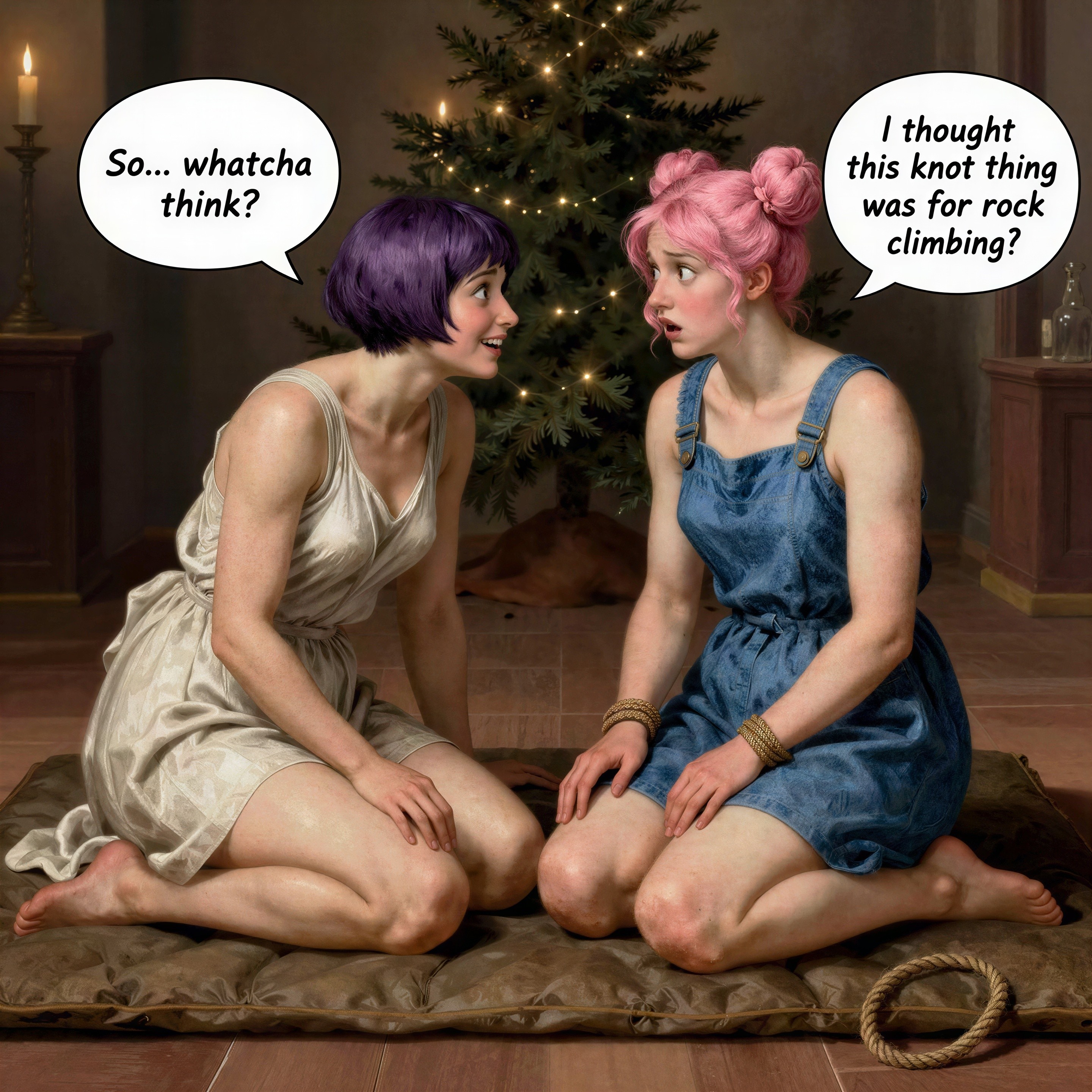
Two young adult women sit facing each other in seiza on a traditional futon, barefoot. Their poses are solid and grounded, as if carved from stone and then brought to life. The setting is a warmly lit interior rendered with Renaissance depth: a softly glowing Christmas tree stands in the background, slightly out of focus, its lights diffused like candle flames, reinforcing a festive but subdued atmosphere.
Left figure:
The first woman wears a short pleated skirt and a light blouse, draped with classical gravity, the fabric falling in heavy, sculptural folds. Her very short, sharply layered asymmetrical pixie haircut is rendered in a deep violet tone, subdued by painterly shading. She leans forward with confident, animated posture, torso engaged, shoulders open. Her expression is lively and teasing—arched eyebrows, bright eyes, and a playful, self-assured smile—captured with the emotional intensity typical of Renaissance faces.
Speech bubble (left woman, enthusiastic but rendered in a simple, legible modern font):
“So… whatcha think?”
Right figure:
The second woman sits upright in seiza, barefoot, wearing a short denim-style overall (salopette), simplified into a painterly garment with heavy texture and solid mass. No t-shirt. Her hair is styled in voluminous pink double buns, softened by shadow and light rather than sharp edges.
Her wrists and ankles are loosely bound with ordinary rope, depicted clearly but neutrally—functional, not decorative, with no erotic emphasis. The rope is thick, natural fiber, resting against the skin without tension, reading as a situational misunderstanding rather than restraint.
Her posture is slightly rigid, shoulders subtly raised. Her expression shows surprise and embarrassment: widened eyes, parted lips forming an awkward half-smile, conveying confusion rather than distress.
Speech bubble (right woman, flustered and sincere):
“I thought this knot thing was for rock climbing!”
The lighting is dramatic and directional, with strong chiaroscuro: warm highlights 3d faces, arms, and knees; deep shadows anchor the figures to the futon and floor. The background remains uncluttered beyond the futon and Christmas tree, ensuring focus on body language and facial expression.
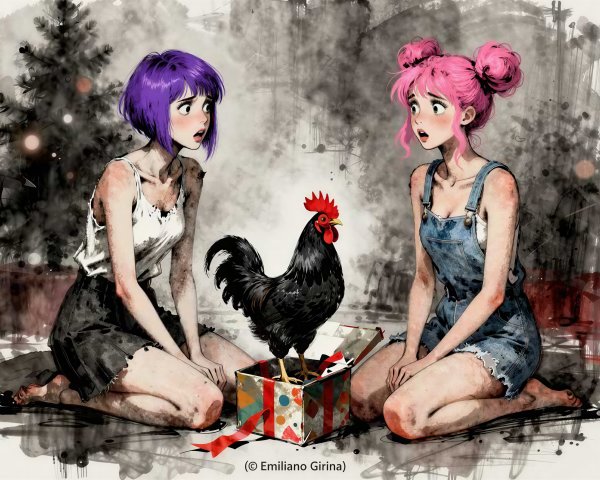
At the bottom center, just above the lower edge of the illustration, a discreet caption reads:
“(© Emiliano Girina)”
The overall mood is playfully awkward yet dignified, blending Renaissance gravitas with modern humor—surprise and miscommunication rendered with the visual seriousness of a fresco, creating ironic contrast without explicit content.

 Artist