
Comments
Loading Dream Comments...
You must be logged in to write a comment - Log In
 Artist
The villagers said the cliffs were older than memory—older even than the wind that carved its initials into every stone, every thorn, every stubborn scrap of green clinging to the slopes. To Lirio, who had walked the whole length of the Cobalt Peninsula since childhood, the place felt like a half-awake creature: breathing in slow tides, dreaming in blue gradients, listening with its maze of brittle shrubs.
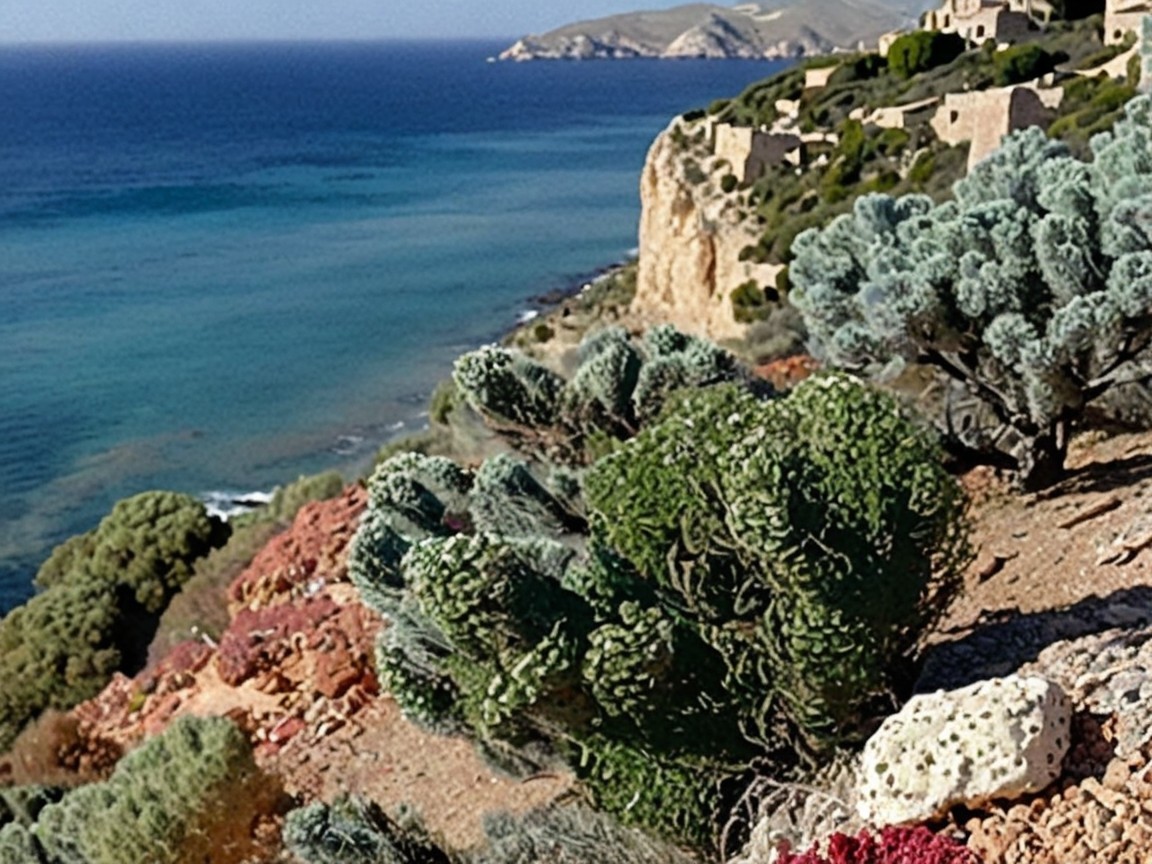
He came here whenever the world pressed too loudly upon him. Today was one of those days. He followed the narrow goat-path that skimmed the edge of the drop, red dust rising against his boots like a rust-coloured ghost. The sea below shimmered in overlapping turquoise panes, as if someone had shattered a window made of water and left the pieces floating in place.
The strange plants—those knotted, silver-flecked cacti that grew only on this peninsula—leaned toward him as he passed, their frost-green skins whispering against each other. Locals called them argonaut thorns, claiming they had once been ordinary shrubs before absorbing centuries of salt wind and shipwreck stories. Lirio believed them. Each plant had a look of quiet vigilance, as though it had seen too much and chosen silence as a shield.
Scattered across the cliffs were ruins: old stone dwellings built by a vanished seafaring people. Their square windows faced the horizon with the unwavering patience of abandoned watchtowers. Lirio often imagined them still inhabited, the air behind each window holding the faint echo of a life paused mid-gesture—hands still on clay jars, sandals still by the door, a bowl of figs eternally half-eaten.
He reached his favourite outcrop, where a pale porous stone sat like a forgotten offering. He knelt beside it, brushing sand from its pitted surface. Rumour said the stone was a fossilized coral head carried up here by a great storm in an age before names. He liked the idea that the sea occasionally gifted the land a piece of itself, as if reminding it they were kin.
Below him, the tide exhaled. Above him, the ruined village waited.
Lirio closed his eyes.
He could almost hear the peninsula speak—not in words, but in a long braided hum of sea, stone, and wind. The hum carried stories: of sailors who navigated by the pulse of stars, of women who painted their houses the colour of dawn so that morning would arrive faster, of children who believed the cliffs were the vertebrae of a sleeping dragon.
And woven through all of it was another story, quieter but persistent: that anyone who listened long enough would learn where they truly belonged.
Lirio opened his eyes. The plants shimmered silver in the angled sun. The ruins glowed faintly gold. The sea, as always, stitched the world together with blue thread.
He stood and began walking again, letting the trail pull him forward—not toward an answer, but toward a place where questions could finally breathe.