Comments
Loading Dream Comments...
You must be logged in to write a comment - Log In
 Artist
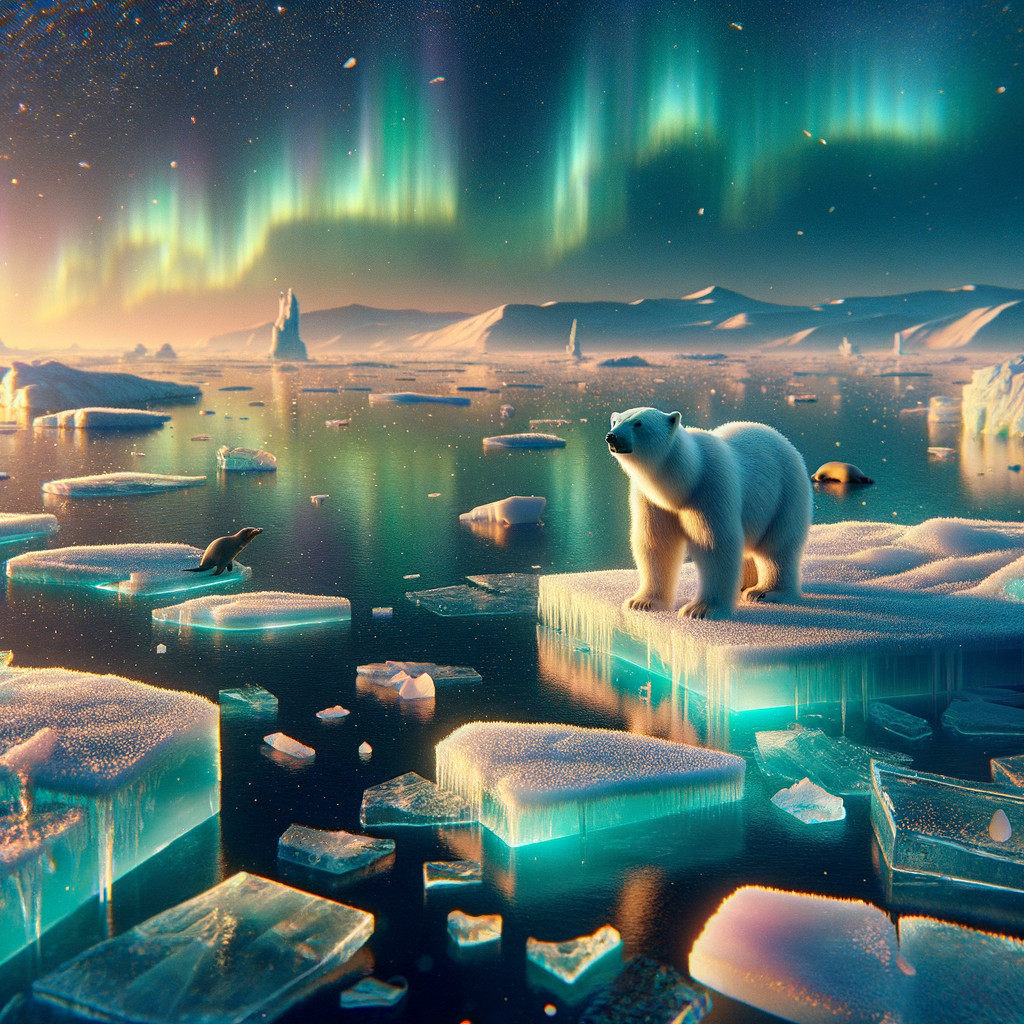
Produce a monumental, cinematic polar scene of a polar bear standing on fragmented sea ice beneath a dramatic arctic sky. Composition: bear on foreground floe, oceanscape with distant aurora and crumbling ice behind, small seal breathing hole visible nearby. Lighting: cold, high-contrast daylight with gold-pink twilight near horizon; subtle aurora greens above. Texture: dense fur rendered with micro-detail, frost crystals on whiskers, water droplets on paws; translucent ice with internal fissures and blue subsurface glow. Palette: arctic blues, icy cyan, pale pink, soft aurora green. Depth & 3D: layered foreground ice with pronounced parallax, mid-distance water reflecting fractured ice, atmospheric haze; 3D volumetric light shafts. Style-mix options: combine the atmospheric melancholy of Turner (for sky/sea) with the tactile detail of Bouguereau for fur realism, or a contemporary environmental poster look with conceptual minimalist elements (González-Torres-inspired empty plinth nearby to signal loss). Camera & output: 35–50mm cinematic shot, 6k+ for large-format print. Variations: mother and cubs at den entrance, night aurora scene, or conceptual conservation poster with text panel. RY
**Polar Bear
Scientific name: Ursus maritimus
Typical lifespan: ~20–30 years in wild (varies).
Gestation: Delayed implantation; total reproductive cycle ~195–265 days including denning (cubs born after den period).
Diet: Hypercarnivore -seals (primary), fish, carrion.
Role in nature: Arctic apex predator, controls seal populations and influences marine mammal behaviour.
Range / countries: Circumpolar Arctic -Canada, Greenland, Russia, Norway (Svalbard), USA (Alaska).
Size / height: Standing height up to 2.5–3 m on hind legs.
Weight: Adult males 350–700+ kg; females smaller (150–300 kg).
Bite force: Very strong - adapted for tearing blubber and flesh; measured values vary but overall very powerful.
Vision / hearing: Good vision; hearing acute for low- to mid-frequency sounds; strong olfaction (can detect seals under ice far away).
Abilities: Excellent swimmer (long-distance), strong fat insulation and compact fur with hollow guard hairs.
Conservation: Vulnerable - climate-change driven sea-ice loss is major threat.
Extra: Solitary, long-distance wanderers; maternal dens in snowdrifts.
2025 August 25
-Rojitha yasaswin