Comments
Loading Dream Comments...
You must be logged in to write a comment - Log In
 Artist
Extract from TTA Civilian Field Reference, Vol. 6 (Unpublished Draft)
Section 3.12 — Cultural Environments & Open-Air Commerce Zones
Of all the worlds admitted into the chartered lanes during the Second Expansion Era,
Altair IV remains the most frequently cited by field officers as the place they “would
live, given the chance.” Analysts often attribute this sentiment to the planet’s
temperate equatorial zones, its stable coastal climates, or the architectural cohesion
mandated by the Altairan Urban Integration Accords of 2267. But those who have
walked its thoroughfares know the truth is simpler: Altair IV feels lived-in in a way few
frontier worlds ever do.
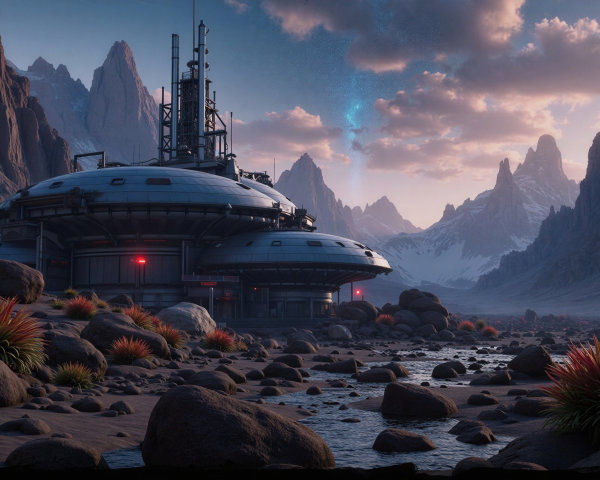
The Old Port Market, pictured above at mid-morning cycle, is typical of the planet’s
municipal design philosophy. Suspended transit platforms drift on calibrated grav-
guides overhead, moving no faster than local eye-lines can comfortably track.
Ground-level stalls operate with minimal automation, a deliberate civic choice
intended to preserve the world’s pre-Authority heritage of open-air bargaining.
Vendors from half a dozen systems maintain permanent stands here, yet the
prevailing tone remains unmistakably Altairan—unhurried, approachable, quietly
cosmopolitan.
Visitors often remark on the ease with which advanced infrastructure blends with
vernacular life. Power conduits, atmospheric recyclers, and broadcast nodes are
housed within warm-toned façades shaped by generations of artisans rather than
industrial template presses. Even the orbital spires, visible in the haze beyond the
district perimeter, operate at a respectful remove, their presence never
overshadowing the human scale of daily commerce below.
The Market’s peak hours coincide with the late-afternoon sunfall, when food vendors
begin simmering evening stews and the pedestrian flow thickens with workers
returning from the aerostat foundries. Despite its density, the district maintains one of
the lowest incident rates in TTA space—an achievement attributed not to heightened
security, but to the long-standing Altairan custom of situational reciprocity: everyone
sees, and is seen, in equal measure.
Travel advisories note no significant hazards in the district beyond occasional
pickpocket novitiates from the Academy Quarter, whose attempts are widely
regarded as “practice runs” and seldom pursued legally. Most visitors find
themselves lingering longer than intended; it is, after all, the sort of place where even
veteran officers forget the hour.
No major historical events have occurred here.
No battles were fought.
No treaties signed.
And yet, for many who chart the stars for a living, it is this unassuming market—with
its hum of voices, its drifting shadowcraft, and its aroma of spiced grains—that
remains the clearest reminder of why interstellar travel was pursued in the first place:
to discover places that feel, against all expectation, like home.