
Comments
Loading Dream Comments...
You must be logged in to write a comment - Log In
 Artist
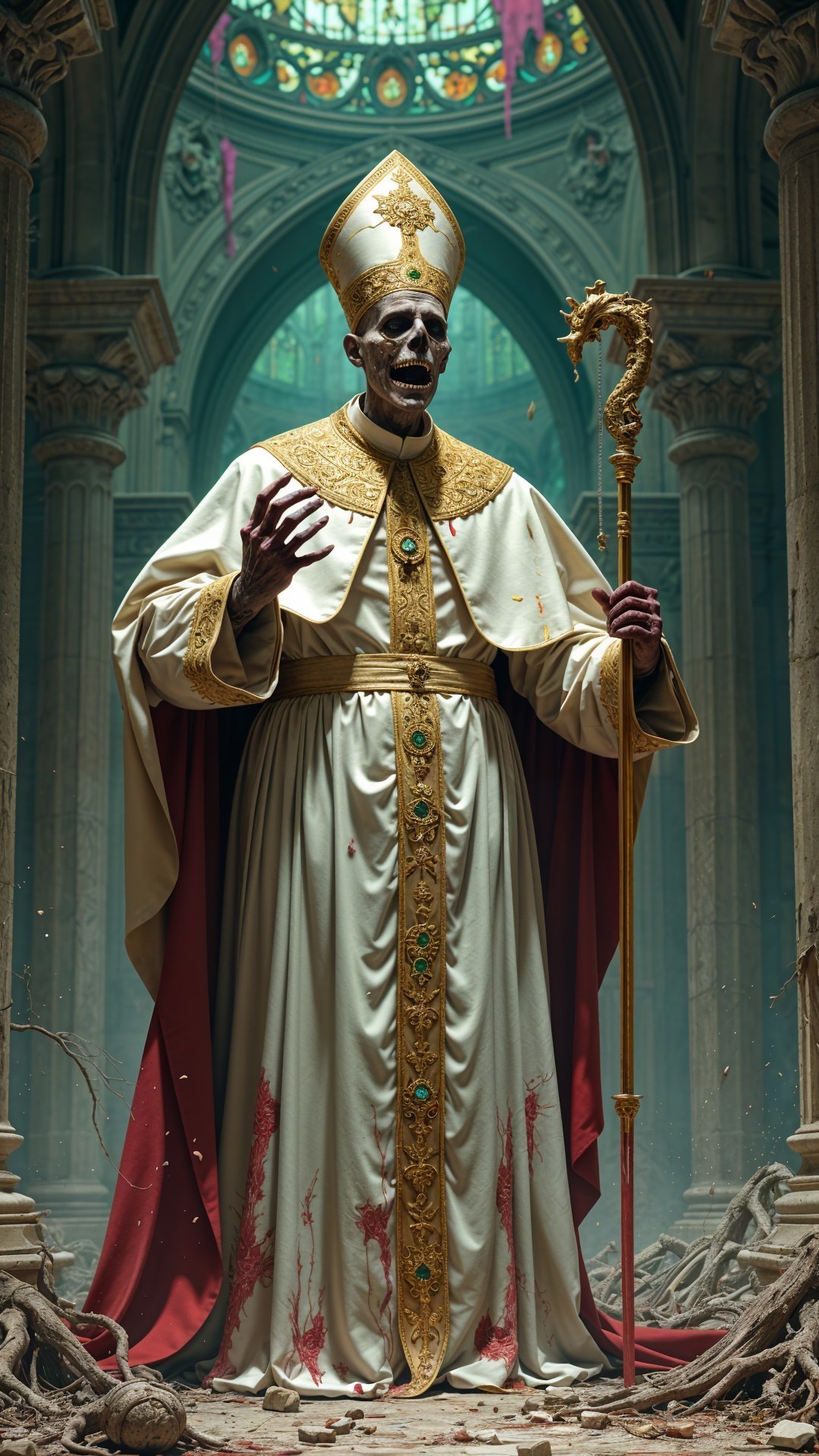
Full-body illustration in a nightmarish, surreal style, blending grotesque hyperrealism with spectral abstraction. The subject is a decayed, cadaverous pope — his body skeletal, skin greyish and rotting (Pantone 425 C, ash grey, and Pantone 7528 C, pallid flesh tones with necrotic stains of Pantone 4975 C, dark brown). His face is hollowed, lips cracked, teeth exposed in a grotesque rictus, yet his papal regalia is immaculate: a pristine, radiant white cassock (Pantone 11-0602 TCX) with golden embroideries (Pantone 871 C) and deep crimson details (Pantone 7621 C). The mitre gleams with polished gold filigree and inset emeralds (Pantone 356 C), untouched by decay, emphasizing the obscene contrast between his own corruption and the wealth he carries. In one hand, he holds a staff adorned with intricate baroque ornamentation, polished and radiant, while his fingers are skeletal, nails blackened and splitting. His other hand, bony and veined in sickly hues (Pantone 405 C, bruised brown-grey, with streaks of Pantone 7642 C, dried blood crimson), extends outward in a grotesque parody of blessing. His body emanates an aura of rot, a slow miasma of shadowy tendrils that dissolve into the air, in stark dissonance with the dazzling splendor of his garments. The background is an apocalyptic cathedral interior, crumbling stone arches (Pantone 425 C, dark slate) with streaks of moldy green (Pantone 7763 C) and fractured stained glass windows spilling twisted, spectral light in hues of violet (Pantone 2597 C) and sickly yellow (Pantone 393 C). The floor is littered with fragments of broken relics and faded icons, scattered among creeping roots and ash, symbolizing spiritual collapse under the weight of ostentatious wealth. The overall mood is one of obscene contradiction: a pope who is little more than a rotting corpse, yet wrapped in immaculate symbols of power and luxury. The composition exudes decadence, hypocrisy, and moral corruption, merging deathly grotesque with opulent splendor in a haunting vision of decayed holiness.
The Catholic Church has long claimed to stand with the poor, the humble, and the marginalized, building its identity on the Gospel narrative of simplicity and sacrifice. Yet its institutional reality is one of immense wealth, gilded palaces, priceless art collections, and a clerical elite living in comfort far removed from the struggles of ordinary people. This contradiction between doctrine and practice is not an accident of history, but the very foundation of its hypocrisy.
The clergy, from the lowest ranks to the papacy itself, preach austerity, humility, and detachment from material possessions, while simultaneously indulging in the luxuries of power and influence. The Vatican, adorned with gold and marble, symbolizes not the kingdom of God on Earth but the decadence of a political institution more concerned with maintaining authority than embodying its professed values.
The moral decay of the clergy is revealed in countless scandals: corruption, abuse of power, financial manipulation, and the systematic silencing of dissent. These are not isolated missteps but symptoms of a deeply entrenched culture of privilege and impunity. The very men who call themselves shepherds of souls too often behave like princes guarding their thrones, using fear, guilt, and ritual to preserve their dominion.
The papacy, in particular, embodies the sharpest of these contradictions. Proclaiming itself the successor of Peter, the humble fisherman, it has historically aligned itself with emperors, kings, and dictators, consolidating temporal power while speaking of divine love. Its claims of moral authority ring hollow when measured against centuries of complicity in oppression, exploitation, and intolerance.
The falsity lies in the rhetoric of service contrasted with the reality of domination. The Church presents itself as a moral compass, yet its hierarchy frequently bends truth to preserve its image and authority. It extols poverty as a virtue, but only for others. It preaches humility, but not for those enthroned in scarlet robes. It proclaims compassion, yet condemns human variety, diversity, and freedom of thought.
To expose this hypocrisy is not to deny the faith of individuals who seek meaning and hope, but to reject the institutionalized machinery that masks decadence with sanctity. The contradiction between word and deed is too glaring to be ignored. A Church that claims to embody the truth must first reckon with its own falsehoods, and a papacy that claims moral primacy must confront the rot of its own corruption.


