Prompt:
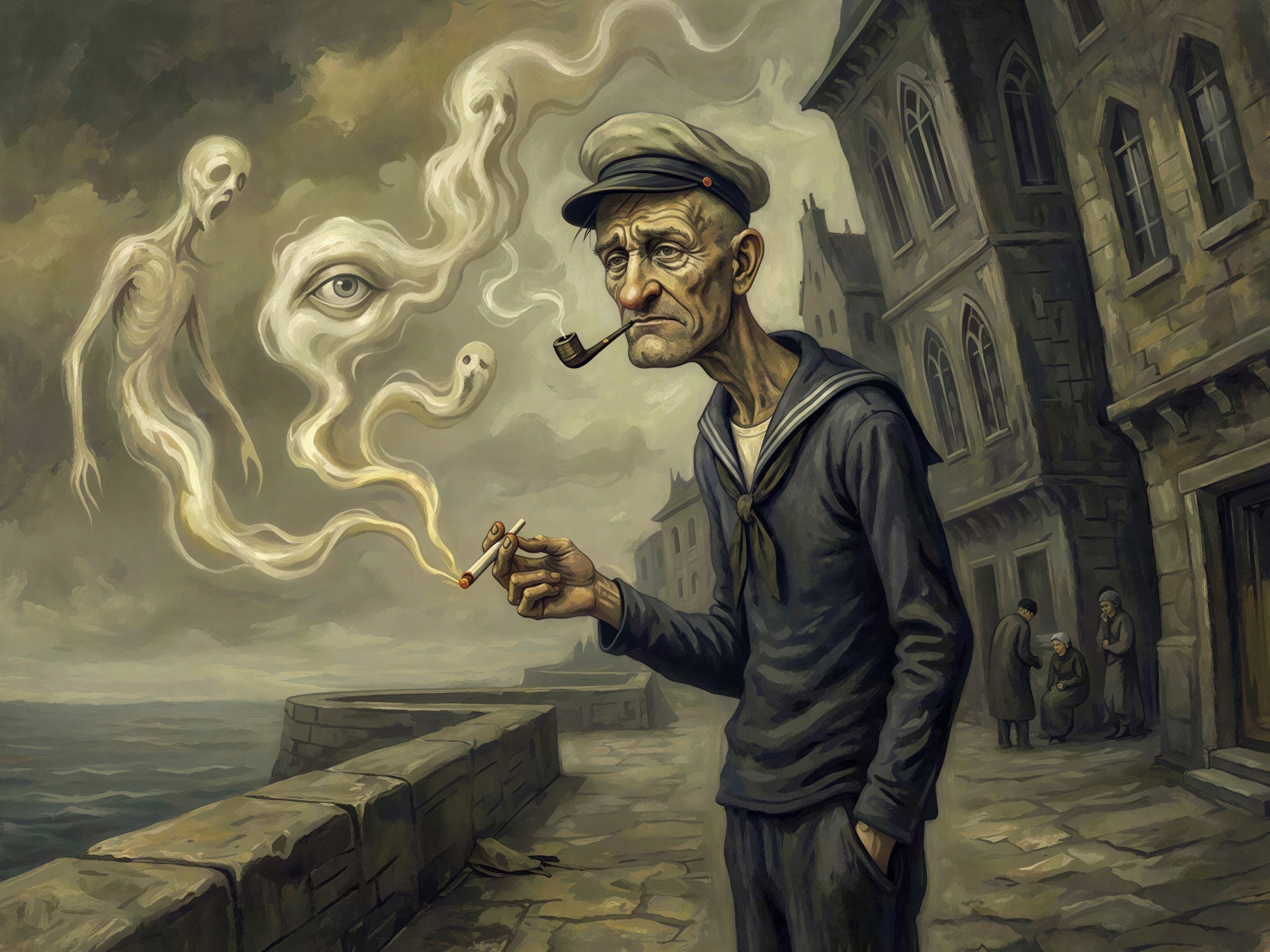
rendered as if painted jointly by Francisco Goya and El Greco. Elongated forms, uneasy proportions, spiritual tension in the figures, with Goya’s somber psychological weight and muted, earth-dark palette. Popeye the Sailor stands as the central figure, stretched slightly taller than natural, calm but inwardly distant. He is smoking a small hand-rolled joint, treated without humor or rebellion—solemn, ordinary, almost ritualistic.
The setting is a quiet seaside town, stripped of cheer: overcast sky, sickly light, heavy air. Architectural lines are rigid yet subtly warped, receding unnaturally upward in El Greco’s vertical perspective. Brushwork is painterly, visible, grave. Colors are ochres, ash-grays, bruised blues, nicotine yellows. The world itself remains stable, mournful, and restrained.
All cracks exist only in the smoke.
The smoke rises thick and luminous against the darkened sky, behaving incorrectly: it coils into elongated, anatomical shapes reminiscent of souls or spirits. One plume forms a pale, watchful eye, rendered with disturbing precision before thinning away. Another strand bends against the wind and casts a shadow darker than the figure below. A vertical column of smoke stretches upward too far, thinning into impossible height, echoing El Greco’s spiritual ascents. Highlights within the smoke suggest an unseen, colder light source, as if illuminated from another realm.
Popeye does not react. The town does not react. The painting maintains solemn restraint. Only the smoke betrays metaphysical instability—Goya’s horror leaking through El Greco’s heavenward distortion.
Grave, devotional, psychologically oppressive—until the smoke reveals what the world refuses to acknowledge.

 Artist