
Comments
Loading Dream Comments...
You must be logged in to write a comment - Log In
 Artist
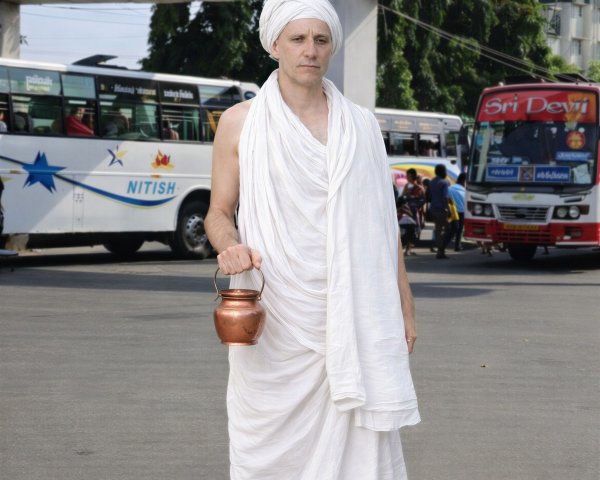
Fulcanelli can be understood not as an eccentric symbolist or a romantic relic of medieval thought, but as a Western siddha: a practitioner whose knowledge was inseparable from discipline, bodily risk, and a private operational language. Like the Siddhas of South India, Fulcanelli did not present alchemy as belief or allegory, but as a rigorous art whose truths could only be approached through transformation under constraint.
The Siddha does not argue for truth; he survives it. Fulcanelli’s writings insist on the same condition. Matter is not persuaded by symbolism, nor does it yield to intellectual elegance. It responds only when placed within exacting conditions—timing, proportion, environment, and the invisible forces that govern transformation. His insistence on “fields of force” unknown to modern science echoes Siddha understandings of vāyu, tejas, and subtle influences acting prior to chemical reaction. These are not metaphors but conditions: fields in which matter behaves differently, sometimes violently, often destructively.
In Tamil Siddha alchemy, this principle is embodied in Muṟṟu (Muṟpu / Muppu)—the philosopher’s stone not as a single object, but as a prepared condition. Muppu is a catalytic substance, often mineral and saline, activated through repetition, fermentation, and exposure to time, heat, and decay. It does not transmute by contact alone; it alters the field in which matter behaves. Without Muppu, metals remain inert; with it, they enter a different regime of possibility. This conception closely parallels Fulcanelli’s insistence that transmutation depends less on reagents than on the unseen environment governing reaction.
Like the Tamil Siddhas, Fulcanelli wrote in a language that resists extraction. His texts are architectural, encrypted in stone, cathedral ornament, and layered allusion. This was not secrecy for its own sake, but a form of safety. Alchemy kills the inattentive. A language that cannot be directly copied protects both the knowledge and the reader. Poetry, symbol, and riddle are not disguises; they are filters.
Fulcanelli’s disappearance mirrors the Siddha ideal of withdrawal rather than mastery. Completion is not marked by recognition but by erasure. What remains are traces: techniques, warnings, fragments of grammar. Like Siddha verses on Muppu, his writings preserve a way of seeing matter that modern chemistry inherited without acknowledging the cost at which it was acquired.
To call Fulcanelli a Western siddha is not to romanticize him. It is to place him correctly within a lineage of practitioners who understood that transformation is real, dangerous, and indifferent to belief. Alchemy, in this sense, is not mystical chemistry nor symbolic psychology. It is a poetic vision forced to answer to fire, poison, time, and the body. Fulcanelli stands where poetry and matter meet—and where most are wise enough not to follow.