


Comments
Loading Dream Comments...
You must be logged in to write a comment - Log In
Metaphysical painters of early modernism; enigmatic stillness characteristic of de Chirico and Carrà; imagined specifically for backlighting
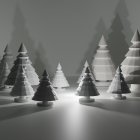
This composition captures the essence of metaphysical painting through its spare, almost austere vocabulary of form—simplified cone-shaped trees rendered as pure geometric solids against a darkened void. The work inherits the enigmatic stillness of de Chirico and Carrà, replacing their urban plazas and classical arcades with a minimalist forest that feels equally dislocating and dreamlike. The trees stand as isolated sculptural presences, their simplified forms suggesting both the familiar and the profoundly strange, creating an uncanny tension between recognition and abstraction. There is a quality of suspended time here, a sense that these geometricized pines exist outside of natural law, arranged with the deliberation of a stage set for some unknowable drama.
The lighting design is where the true conceptual brilliance emerges. The backlighting creates a luminous stage that transforms the scene into a meditation on presence and absence, shadow and revelation. The play of light across the angled surfaces of the cones generates sculptural dimensionality while simultaneously emphasizing their artificial, constructed nature—they are not trees observed from nature but trees *invented* by human geometry. The cool tonal palette and the sharp delineation between illuminated and shadowed zones recall the cool atmospheric melancholy of the Metaphysical painters, that sense of cities and spaces drained of human warmth. The rectangular portal of light in the background acts as a vanishing point that suggests infinite recession, adding to the vertiginous, slightly unsettling spatial logic.
What distinguishes this work is its restraint and its commitment to pure formal investigation. Where de Chirico and Carrà populated their metaphysical spaces with mannequins, architectural fragments, and classical references, this piece allows the geometry itself to carry the philosophical weight. The composition risks austerity—one might argue it borders on the minimal to the point of emptiness—yet this very emptiness becomes its strength, creating a contemplative space where the viewer's gaze can settle into the mysterious relationships between form, light, and shadow. It is metaphysical modernism stripped to its essential vocabulary, inviting us to find profundity in silence and geometric purity.


