Prompt:
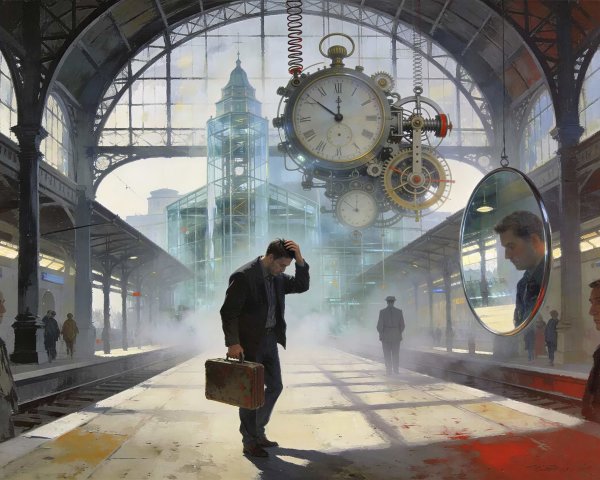
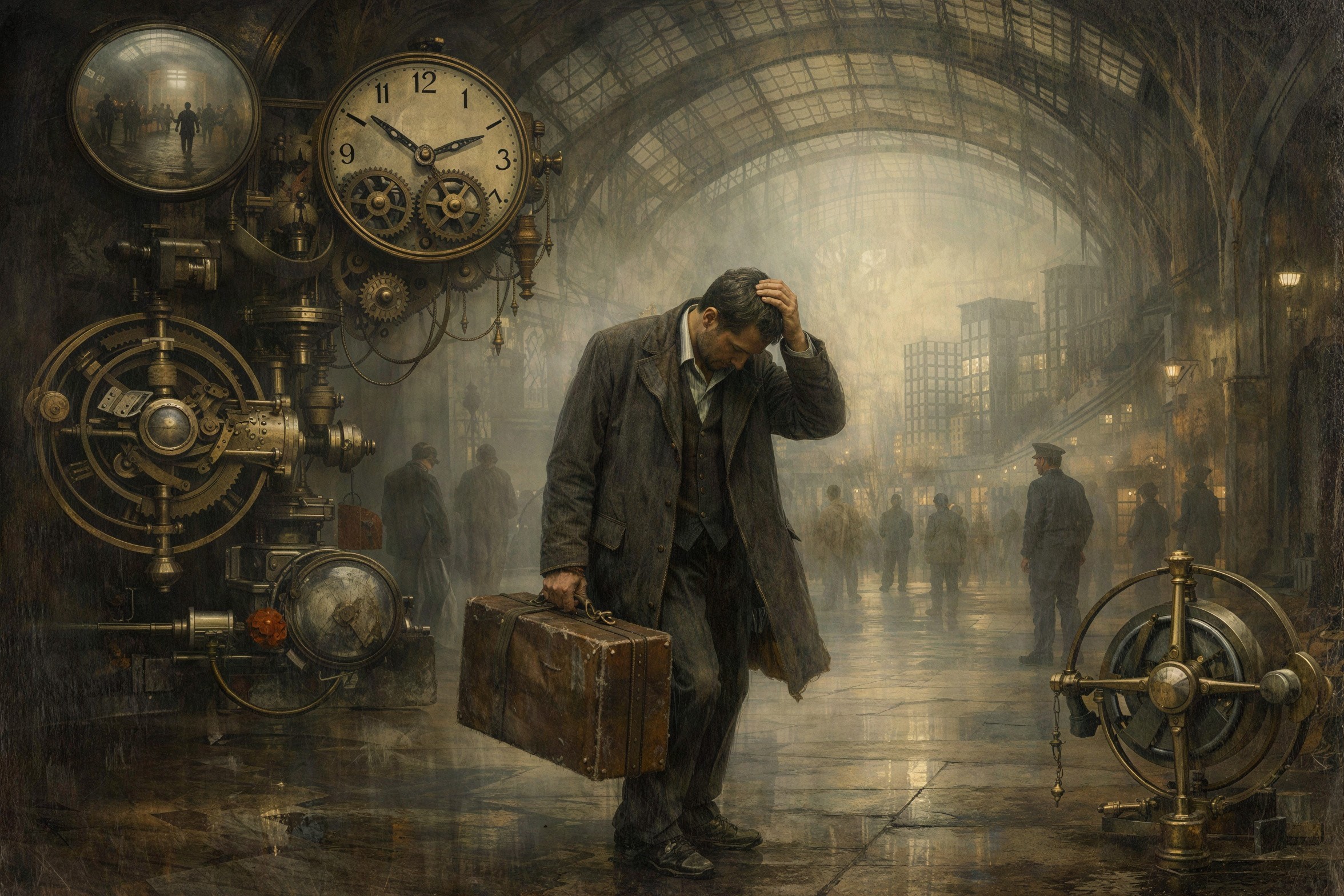
A monumental fine-art oil painting on canvas, symbolic and introspective, set in a vast, dimly lit train station that feels like a metaphysical threshold rather than a real place.
A solitary adult man, not heroic, slightly bent by an invisible lateral force, adjusts the parting of his hair with one hand while holding a worn suitcase with the other. His gesture is small, precise, almost awkward — a ritual of control before the unknown. His posture suggests balance rather than strength.
The station architecture is grand but ambiguous: iron arches, glass vaults, and shadowed corridors dissolve into mist. Time is not linear — behind and around him float exposed mechanical clock mechanisms, marine chronometers with springs, counterweights and gyroscopic systems designed to compensate roll, painted with loving mechanical precision. They do not dominate the scene; they quietly work.
Light enters laterally, cold and analytical, illuminating edges without guiding direction. It reveals surfaces but refuses to lead. Reflections multiply subtly: a small convex mirror embedded in the architecture reflects the entire scene and includes the viewer inside it.
In the background, glass buildings shimmer like fragile temples of modernity — beautiful, clean, but visibly delicate. Their transparency feels vulnerable, almost brittle. Nearby, anonymous figures linger at the margins: ordinary people, worn faces, persistent presences — not victims, not protagonists, simply there. They are partially obscured by scale and perspective, morally central yet compositionally displaced.
A neutral, grey authority figure appears indistinctly — observing, controlling, yet subtly lost. Surveillance increases, meaning decreases. The atmosphere carries restrained pressure, unspoken tension, accumulated weight rather than explosion.
Color palette: restrained and serious — warm greys, iron blues, muted ochres, dirty whites, touches of deep red as contained energy, never decorative. Brushwork is layered, material, visible, with oil texture and depth; no smooth digital finish.
The overall mood is contemplative, ethical, and adult — not nostalgic, not dramatic, not illustrative.
The painting conveys the idea of time as oscillation, maturity as precision within movement, courage as inner posture, technology as ambiguous extension of human will, and humanity as a task rather than a victory.
Style references (implicit, not explicit):
late Turner atmosphere, muted Hopper solitude, moral density of Goya’s late works, Northern Renaissance attention to symbolic detail, contemporary museum-grade realism.
Ultra-high resolution, museum quality, fine-art oil painting, timeless, serious, non-sentimental, morally charged.

 Artist