Comments
Loading Dream Comments...
You must be logged in to write a comment - Log In

 Artist
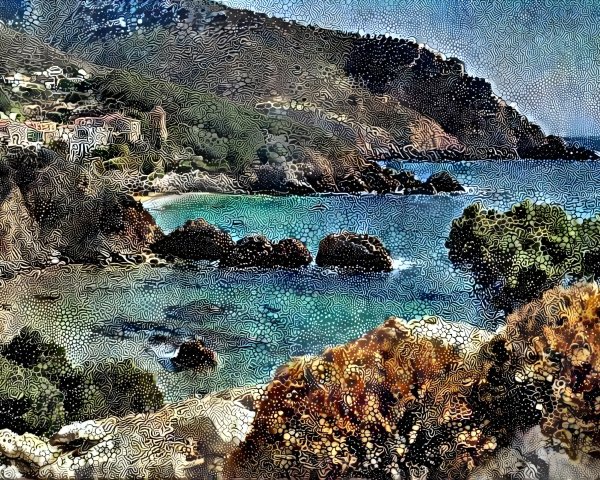
Everyone on Playa de las Cavernas Errantes knew that Rafito el Varado had never left the Rivera—not once, not even during the winter when the waves behaved like melancholy Roman senators arguing with the cliffs. But one Tuesday at dawn he stood up, dusted the sand from his eternal shorts, and announced that he was going to Britain.
“I’ve had a calling,” he said. “A British calling. Very foggy, very polite.”
He didn’t take a bus or a boat. He simply walked into the giant cave at the cliff’s base—the one that sometimes exhaled cold air from improbable worlds—and vanished. Later that day, beachgoers claimed they heard faint bagpipes drifting out of the rock.
Weeks passed. Maybe months. Time near Cavernas Errantes is known to loosen like old shoelaces. Then one morning Rafito reappeared, stepping out of the same cave holding a damp paperback copy of Wuthering Heights and a tin of shortbread biscuits.
He was different.
His tan now had the pallor of overcast afternoons. His hair smelled faintly of peat and unresolved literary feuds. And he walked with the calm resignation of someone who’d recently argued with a ghost on a moor and lost.
Rafito sat beside me on the beach and told his tale.
Britain, it seemed, was a place where cliffs didn’t warm your back—they reprimanded you. The sea wasn’t turquoise but a dignified, brooding gray “with excellent manners.” And the wind spoke in complete sentences, mostly criticisms about his lack of socks.
He wandered Cornwall first, where he befriended a fisherman who claimed to be half-mackerel. They shared philosophical debates about whether tides are memories or predictions. Then Rafito hitchhiked to Wales and accidentally joined a choir that sang only in dreams. The entire group performed in abandoned chapels at 3 a.m., harmonizing with the dust motes.
But the true turning point came in Yorkshire. Rafito found himself on a lonely, wind-clawed hill where he met a translucent woman named Agnes who insisted she had been waiting for him since 1847.
“She was very dramatic,” he explained. “Always floating an inch above the ground and quoting herself.”
Agnes tried to lure him into the local moor, claiming there were doorways hidden in the heather. Rafito, who’d already travelled through too many doorways, declined politely. She took it well—by howling like a storm and disappearing into a cloud.
After that, the British weather lost patience with him. Rain followed him indoors. Fog heckled him on the bus. He concluded Britain itself was trying to edit him into a minor footnote.
“So I came home,” he said, opening the shortbread tin. It was empty—apparently eaten somewhere between dimensions. “Cavernas Errantes is the only place that misbehaves in my favor.”
He leaned back on the sand, letting the warm Rivera sun erase the ghostly shadows of the north. And for the first time since his return, he smiled.
“Britain is lovely,” he said. “But the beaches argue less here.”